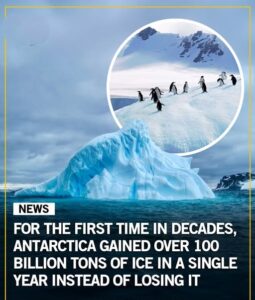
After decades of consistent ice loss, rising global temperatures, and increasing fears about sea level rise, Antarctica has delivered one of the most surprising climate developments in recent history: in a single year, the continent gained more than 100 billion tons of ice.
For a region long viewed as a symbol of the planet’s warming crisis, this sudden boost in ice mass has stunned researchers and raised new questions about the complexity and variability of Earth’s climate systems.
A Rare Break from a Long-Term Decline
For over 30 years, scientific observations have shown that Antarctica has been steadily losing ice due to warming oceans, changing wind patterns, and melting ice shelves. This trend has been widely documented through satellite imagery, climate modeling, and field studies.
The newly recorded ice gain does not overturn that long-term trend, but it represents a rare, temporary reversal—one of the largest one-year shifts ever documented.
Experts emphasize that while the finding is unexpected, it remains an anomaly within an otherwise clear pattern of decline.
Understanding What Actually Happened
Scientists believe several interconnected natural processes may have contributed to this sudden increase in ice mass. Although research is ongoing, early investigations point toward a combination of the following factors:
1. Unusual and Heavier Snowfall
Uncommonly high precipitation in parts of Antarctica may have added a massive amount of snow, which later compressed into ice. In such a cold environment, even small increases in snowfall can significantly impact ice mass measurements.
2. Shifts in Atmospheric Wind Patterns
Stronger or redirected winds can push cold air masses over different regions of the continent. This can create conditions that favor ice accumulation and reduce surface melting. Wind changes can also influence where snow is deposited and how long it remains stable.
3. Colder Ocean Currents Around Key Ice Shelves
Antarctica’s ice shelves—huge floating platforms of ice—are particularly vulnerable to warm ocean water circulating beneath them. Evidence suggests that cooler ocean currents temporarily reduced under-ice melting, helping to preserve ice that would normally be lost.
4. Natural Climate Variability
Earth’s climate system experiences natural fluctuations from year to year, driven by ocean cycles, atmospheric oscillations, and local weather patterns. This one-year gain may simply represent a strong expression of natural variability within a warming world.
Scientists Urge Caution: This Is Not a Climate Reversal
Despite the dramatic numbers, climate experts stress that this ice gain does not signal the end of global warming or Antarctic melting. Long-term data still shows:
-
Ice shelves thinning
-
Glaciers accelerating
-
Sea levels rising
-
Temperatures trending upward
The sudden gain is viewed as an important data point, not a turning point.
According to climate researchers, one of the biggest dangers is misinterpreting this anomaly as evidence that climate change has slowed or reversed. Instead, the event highlights how complex and dynamic Earth’s systems really are.
A Valuable Scientific Opportunity
While surprising, this discovery presents a powerful opportunity for researchers. Studying such anomalies can help scientists:
-
Improve climate models
-
Understand short-term vs. long-term climate interactions
-
Identify how ocean and atmospheric conditions shape Antarctic ice
-
Predict future irregularities that may influence global sea level rise
These insights are crucial not only for understanding Antarctica, but also for forecasting how the planet might behave under increasing climate stress.
A Reminder of Earth’s Unpredictability
Antarctica’s sudden ice gain serves as a reminder that the natural world does not always behave in straight lines or simple patterns. Even in an era of rapid climate change, unexpected fluctuations can—and do—occur.
But while this event provides a momentary shift in the narrative, it ultimately deepens the scientific community’s commitment to understanding the fragile dynamics of the polar regions.
As research continues, the world will be watching closely to see whether this anomaly remains a one-year exception—or marks the beginning of a more complex and shifting climate story than previously understood.
Leave a Reply