The photograph looks still, almost quiet—but it isn’t.
It hums with everything that came before it and everything that would come after.
On the surface, it’s a wedding portrait. A Marine in dress blues stands beside a young bride in white. The backdrop is plain, the lighting formal, the kind chosen to make moments look timeless. But no photographer’s lens could ever fully capture what lived inside that frame.
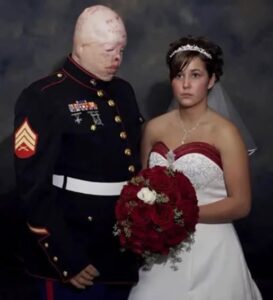
Tyler stands straight, like he was trained to do. His uniform is perfect—pressed, decorated, disciplined. The medals catch the light, small flashes of gold against dark blue. They tell one story: courage, service, survival. But his body tells another. The scars on his face are not hidden. They do not need to be. They are facts, as real as the rank on his sleeve. He has already been to hell and back, and he wears the proof without apology.
Rene stands beside him, holding a deep red bouquet, her fingers wrapped tightly around the stems. The flowers are almost too vivid, like they’re trying to bleed color into a moment that feels heavy with gravity. Her dress is beautiful, carefully chosen, the kind every young woman imagines at least once. But her expression isn’t the dreamy smile people expect from brides. Her eyes are steady. Serious. Brave in a quieter way.
They are both so young.
Tyler is only twenty-four. Rene is twenty-one. Ages when most people are still figuring out who they are, let alone how to survive a lifetime together. Yet here they are, bound by something stronger than romance alone—shared trauma, shared loyalty, shared survival.
Before this photo, there was another world.
There was Tyler before Iraq. Before the explosion. Before the moment that split his life into before and after. Back then, his hands worked without thought. His vision was whole. His face reflected the boy he used to be. He believed, like so many do, that if you gave everything for your country, your country would take care of you in return.
Then came the blast.
In an instant, everything changed. Fire. Noise. Pain so overwhelming it erased sound. He lost his left hand. Three fingers on his right. Part of his skull. An eye. Pieces of himself that would never come back. He survived—but survival came at a cost no one can fully prepare for.
Hospitals replaced battlefields. Bandages replaced uniforms. Silence replaced commands. And slowly, painfully, Tyler learned how to exist again in a body that no longer felt like home.
Rene was there.
She didn’t fall in love with a symbol or a uniform. She loved a man who woke from nightmares drenched in sweat. A man who struggled with frustration, anger, and grief for the life he lost. A man who needed help tying shoes, opening doors, learning new ways to do the simplest things. She stayed—not because it was easy, but because love, real love, rarely is.
Their wedding day wasn’t a fairy tale. It was a promise made in full awareness of hardship. No illusions. No pretending the road ahead would be smooth. When they said their vows, they weren’t just words. They were decisions.
I choose you, even now. Especially now.
But life after the photo was harder than anyone watching could imagine.
Tyler couldn’t return to work. The war had taken too much. He depended on assistance from the Department of Veterans Affairs—paperwork, appointments, waiting rooms, phone calls that went unanswered. Benefits delayed. Forms lost. Promises stalled. Each obstacle chipped away at him, not physically this time, but mentally.
The world applauded his service, but applause didn’t pay rent. Patriotism didn’t heal frustration. And gratitude didn’t quiet the feeling of being forgotten.
The marriage didn’t survive. Not because love wasn’t there—but because sometimes love alone cannot carry the weight of trauma, bureaucracy, and exhaustion. They separated quietly, two young people who had already lived too much life too fast.
And then, in 2012, Tyler’s fight ended.
No battlefield. No explosion. Just a man worn down by years of pain—visible and invisible. A soldier who survived war but could not survive what followed.
He was still young.
Now the photograph remains.
It circulates online, often without context. Some see only shock. Others see inspiration. But if you look closely, you see something deeper: a moment where two people stood together in honesty. No pretending. No filters. Just truth.
Tyler Ziegel was not defined by his injuries, nor by his struggles after. He was defined by his courage—to serve, to survive, to love, and to keep going longer than many could.
This photo is not about tragedy alone.
It’s about sacrifice.
It’s about the cost of war.
It’s about the quiet strength of those who stand beside the wounded.
And it’s about remembering the human beings behind the headlines.
Rest in peace, Tyler Ziegel. 🫡🇺🇸🕊️
You are remembered—not just for how you were wounded, but for how bravely you lived.
Leave a Reply