U.S., Israel, and Iran: A Complex and Enduring Rivalry
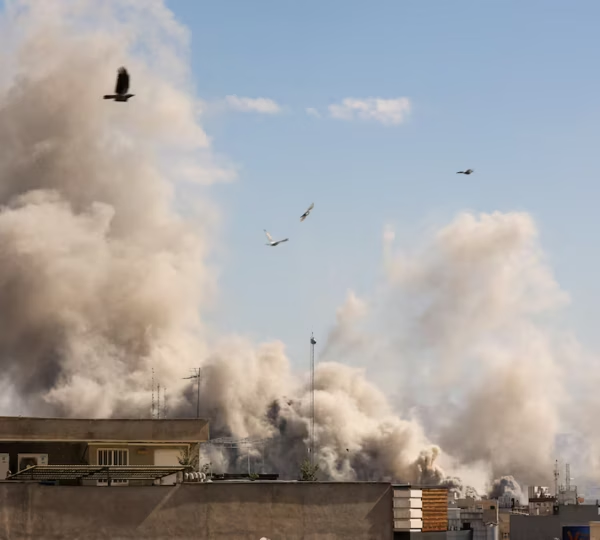
Tensions between the United States, Israel, and Iran have long shaped the Middle East’s geopolitical landscape, creating one of the most persistent and volatile rivalries in modern international affairs. While news coverage and political rhetoric often depict the region as teetering on the edge of large-scale war, a careful review of verified events shows a far more nuanced reality. Despite repeated escalations and heightened military alerts, there is currently no confirmed full-scale war between the U.S. and Iran, nor evidence of a coordinated, sustained invasion or nationwide bombing campaign inside Iranian territory by American and Israeli forces. Understanding the seriousness and complexity of the situation requires examining history, strategy, diplomacy, and the broader regional security framework—not just reacting to dramatic headlines.
Historical Roots of a Deep-Running Conflict
The modern U.S.-Iran confrontation traces back to the 1979 Iranian Revolution, a turning point that fundamentally reshaped Iran’s political identity and foreign policy. That year, the U.S.-backed Shah of Iran was overthrown, and the Islamic Republic was established under clerical leadership, significantly altering the regional balance of power.
Diplomatic relations between the United States and Iran collapsed shortly afterward during the U.S. Embassy hostage crisis in Tehran, and formal ties have never been restored. Over the decades, interactions have been defined by economic sanctions, ideological hostility, and ongoing strategic competition.
For Israel, the post-revolutionary transformation in Iran created a new and enduring security concern. Iranian leaders have repeatedly criticized Israeli policies and questioned the legitimacy of the Israeli state. Ali Khamenei, Iran’s Supreme Leader, has openly opposed Israeli government actions, particularly regarding Palestinian issues.
Israeli officials view Iran’s growing missile capabilities and regional alliances as a long-term strategic threat. Tehran’s support for armed groups across Lebanon, Syria, Iraq, and beyond, combined with advancements in missile technology, is seen as a persistent challenge to Israel’s national security.
The Nuclear Question: Diplomacy, Distrust, and the JCPOA
At the heart of international tensions is Iran’s nuclear program. Iranian officials maintain that their nuclear activities are strictly for civilian purposes, including energy production and scientific research. Yet Western governments and international monitoring agencies have consistently questioned the program’s scope, transparency, and long-term intentions, particularly regarding uranium enrichment.
In 2015, Iran reached a landmark agreement with world powers known as the Joint Comprehensive Plan of Action (JCPOA). The deal aimed to limit Iran’s nuclear activities in exchange for sanctions relief and heightened international oversight. Negotiated under the administration of former President Barack Obama, the JCPOA was widely hailed as a major diplomatic breakthrough.
The situation changed in 2018, when then-President Donald Trump
Following the withdrawal, Iran gradually eased its compliance with certain JCPOA provisions, including exceeding previously agreed-upon enrichment limits. Since then, attempts to revive or renegotiate the agreement have produced no comprehensive solution.
Throughout this period, the International Atomic Energy Agency has continued monitoring Iran’s nuclear program, issuing periodic technical reports that shape policymaking in Washington, European capitals, and other global centers of influence.
Israel, the U.S., and Iran: Strategic Rivalry Without Open War
Israel’s Security Doctrine and the “Shadow War”
Israeli Prime Minister Benjamin Netanyahu and other top officials have long maintained that Israel will act to prevent Iran from obtaining nuclear weapons. Central to Israel’s security strategy is the principle of preemptive action against perceived existential threats.
While Israel has conducted airstrikes in Syria targeting Iranian-linked military infrastructure, there has been no confirmed large-scale bombing campaign across Iran itself. Most Israeli operations focus on limiting Iran’s military presence in Syria, especially near Israeli borders. Security analysts often describe this approach as a “shadow war,” conducted through intelligence operations, cyberattacks, targeted strikes, and indirect engagements rather than conventional declared warfare.
Military Posturing Without Declared War
Although tensions remain high, there are no confirmed major combat operations amounting to a formally declared war between the United States and Iran. Instead, the region has experienced cycles of measured escalations, including:
-
Israeli airstrikes on Iranian-linked positions in Syria
-
Rocket and drone attacks by Iranian-aligned groups in Iraq and Syria
-
Maritime incidents in the Persian Gulf
-
Limited U.S. retaliatory strikes following attacks on American personnel
These actions, while serious, typically remain below the threshold of open warfare. U.S. responses to attacks on its forces in Iraq and Syria are described as defensive and proportional, rather than offensive campaigns aimed at provoking broader conflict.
The U.S. Military Presence in the Region
The United States maintains a substantial military footprint across the Middle East, with bases in Qatar, Bahrain, Kuwait, the United Arab Emirates, and Jordan. These installations support counterterrorism operations, maritime security, intelligence coordination, and regional deterrence.
Iranian-aligned groups have occasionally launched rockets or drones at U.S. facilities, prompting limited retaliatory strikes. However, these exchanges have remained contained, and there is no evidence of a coordinated Iranian missile campaign targeting multiple U.S. bases as part of a declared war.
Airspace Precautions and Public Perception
During periods of heightened tension, some Middle Eastern nations implement temporary airspace restrictions as a precaution, causing localized flight rerouting. Political rhetoric can amplify public concern, but there is no verified statement from former President Donald Trump declaring an operation called “Operation Epic Fury,” nor evidence of a coordinated U.S.–Israeli nationwide bombing campaign in Iran. Distinguishing verified reporting from social media claims is essential.
The Risk of Miscalculation
Even without declared war, risks remain. The region’s overlapping proxy conflicts, complex alliances, and fragile deterrence structures mean that missteps could escalate rapidly. Analysts highlight potential triggers such as:
-
Misinterpreted troop movements
-
Cyberattacks on critical infrastructure
-
Civilian casualties from limited strikes
-
Escalatory actions by non-state armed groups
-
Maritime confrontations in the Persian Gulf
Back-channel diplomacy and crisis communication are critical tools to prevent unintended escalation.
Global Stakeholders and International Implications
Global actors, including the European Union, Russia, and China, routinely call for restraint during tense periods, emphasizing diplomacy and adherence to international agreements. The International Atomic Energy Agency continues to monitor Iran’s nuclear program, with reports shaping policy decisions worldwide. Preventing escalation is crucial for global energy markets, shipping routes, and regional stability.
Current Reality
Based on verified reporting:
-
There is no confirmed full-scale war between the U.S. and Iran.
-
Iran’s Supreme Leader, Ali Khamenei, remains alive.
-
No military operation named “Operation Epic Fury” has been confirmed.
-
Current tensions reflect strategic rivalry rather than declared interstate war.
Conclusion: Strategic Rivalry, Not Open Conflict
The triangular relationship between the U.S., Israel, and Iran remains one of the most intricate dynamics in global geopolitics. Historical grievances, nuclear negotiations, regional power struggles, and proxy engagements create persistent tension.
Responsible reporting requires separating verified facts from dramatic but unconfirmed claims. While the Middle East faces real security challenges, there is no evidence of a massive U.S.–Israeli assault across Iran or the death of its Supreme Leader.
In an era of rapid information flow and viral speculation, relying on verified sources is essential for informed discussion on conflict, diplomacy, and the delicate balance between deterrence and war.
Leave a Reply