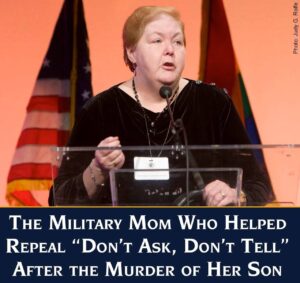
Military mom Patricia Kutteles fought for over a decade to repeal the US military’s “Don’t Ask, Don’t Tell” policy after the murder of her son in 1999. Following months of homophobic bullying, Kutteles’ son, Barry Winchell, was beaten to death by a fellow soldier while sleeping in his barracks. After testifying at the trial of his killer, Kutteles spent years advocating for an end to the discriminatory policy which she said “says to other service members that gays in the military are second-class citizens, that they are not worthy of the respect dictated in the Army’s values.”
In a statement after the conviction of her son’s killer, Kutteles further asserted: “We knew Barry could be deployed and come into harm’s way for our country. We never dreamed that he would be killed by labeling, prejudice and hatred at home. ‘Don’t ask, don’t tell, don’t pursue’ did not protect our son. It won’t protect anyone else’s child. This policy must end. Those who assert that the law serves to protect gays in the military are wrong — it corroborates the fears and bigotry of those who are anti-gay. Worse, it encourages those who are prone to violence to act on their rage.”
Winchell, an aspiring helicopter pilot, was 21 years old when rumors began to spread about his sexuality after he started dating a transgender woman. At the trial after his death, his section leader testified, “Pretty much everybody in the company called him derogatory names” but that he didn’t put a stop to it because “everybody was having fun.” Kutteles said in an interview that she never knew if her son was gay or not but that “it didn’t matter to me one way or the other, and Barry would know that;” what mattered, she asserted, was “t he fact is, he was murdered, and he was on an Army base, where we thought he was safe.”
After Winchell’s murderer was convicted and sentenced to life in prison — but the officers who allowed the harassment were deemed not at fault — Kutteles became a fierce advocate for the repeal of “Don’t Ask, Don’t Tell.” Working with the LGBT advocacy group Outserve-SLDN, now the Modern Military Association of America, she spoke on Capitol Hill, filed a wrongful death claim against the Army accusing the officers of neglect, and pressured the Pentagon to launch an investigation which found widespread anti-gay harassment in the military.
OutServe-SLDN’s director Matthew Thorn praised her efforts in a tribute, stating: “Pat’s voice was pivotal in the repeal of ‘don’t ask, don’t tell.’ In what I can only imagine was a most difficult time for her she had a resolve to share her son’s story and her story as a mother, losing her son because of anti-gay violence and harassment, and went beyond the law in helping individuals to understand lesbian, gay, bisexual and transgender people on a human level.”
In 2011, under President Obama, the “don’t ask, don’t tell” policy was repealed, allowing gays and lesbians to serve openly in the military for the first time in history. Kutteles had one of the pens the president used to sign the repeal framed on her wall. Throughout her long battle for justice, Kutteles, who passed away in 2016 at the age of 67, said that her son was always her inspiration: “I hear him now, over and over, telling me, ‘Suck it up, Mom, and drive on,’ [his basic training motto.] Everything I’m doing is for him: Suck it up and drive on.”
The hard-won progress that Patricia Kutteles and countless other advocates fought for after her son Barry Winchell’s murder is now being systematically reversed under Donald Trump and Pete Hegseth. In January, Trump signed an executive order banning transgender people from enlisting and serving openly in the military, declaring that being transgender is “not consistent” with military values. By March, the Pentagon began separation proceedings against the estimated 4,240 transgender service members currently serving.
Hegseth declared “No more dudes in dresses” in a May speech to special forces operators and ordered the renaming of the USNS Harvey Milk — a ship honoring the Navy veteran who was one of the first openly gay elected officials in the U.S. — which was announced at the beginning of June’s Pride Month and completed later that month. These actions, along with Hegseth’s characterization of LGBTQ+ inclusion as a “Marxist agenda” undermining military effectiveness (stated in his 2024 book and public appearances before becoming Defense Secretary), echo the same harmful stereotypes that created the hostile environment for Winchell’s murder.
As today’s military under Hegseth and Trump reverses many of the hard-won protections for LGBTQ+ service members, we must remember these are not merely abstract policy debates but decisions directly impacting the safety and lives of those volunteering to serve their country. Barry Winchell’s tragic death stands as a sobering reminder that when institutions endorse discrimination, even tacitly, they can embolden the worst impulses of bigotry and violence, with costs sometimes measured in human lives.
Leave a Reply