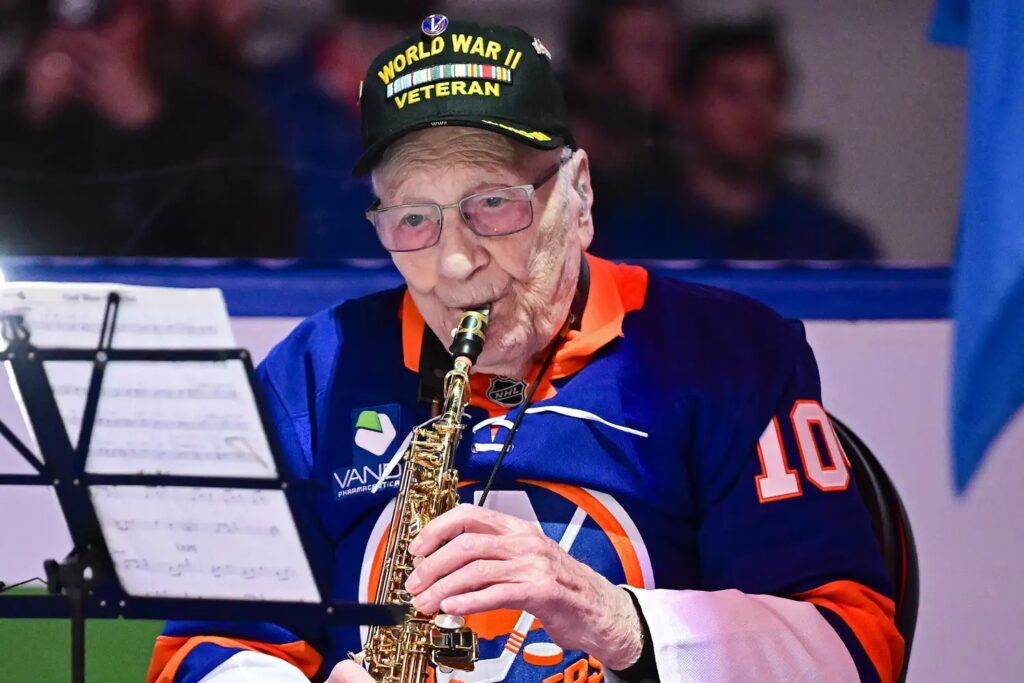
What followed was a stirring, note-perfect rendition of “The Star-Spangled Banner” — not sung, but breathed through brass and memory.
Critelli has played the saxophone since he was 13 years old, long before war would reshape his life. Music, he says simply, makes him happy. “I practice every day,” he told NBC News, as casually as someone mentioning a morning walk. But on this night, the performance carried far more weight than routine or tradition.
“I lost a lot of friends,” Critelli said quietly, referring to the soldiers he served beside during World War II. “I’m doing this for them.”
Born in 1920, Critelli came of age during the Great Depression and was thrust into adulthood by global war. As a staff sergeant in the U.S. Army, he fought in Europe and survived the Battle of the Bulge — one of the deadliest and most defining campaigns of the war. The freezing conditions, relentless combat, and staggering loss of life left scars that never truly faded.
Yet there he stood, more than eight decades later, steady on his feet, horn in hand, honoring those who never made it home.
This wasn’t Critelli’s first appearance at UBS Arena. In 2023, he performed there as well, earning admiration for both his musicianship and his age-defying presence. But this year’s performance felt different — heavier, more urgent, as the generation that fought World War II continues to dwindle.
As the final notes of the anthem rang out, something remarkable happened: fans from both teams rose to their feet together. Islanders and Rangers supporters — divided by loyalty for the rest of the night — stood united in applause. Some wiped away tears. Others placed hands over hearts they hadn’t realized were pounding so hard.
Before leaving the ice, Critelli turned and offered a crisp salute to the crowd.
The response was immediate and thunderous.
“U-S-A! U-S-A! U-S-A!”
The chant bounced off the rafters, rolled through the arena, and spilled into the night. Critelli later admitted he barely noticed it. He was too focused on the music, on getting each note right, on the faces he still sees when he closes his eyes.
That quiet humility is part of what makes his story so powerful. Despite his age, his service, and the reverence shown to him, Critelli doesn’t see himself as a hero. He sees himself as a man who was lucky enough to come home — and obligated to remember those who didn’t.
In a time when patriotism is often argued, analyzed, or politicized, Critelli’s performance cut through the noise. There were no speeches. No slogans. Just a veteran, his instrument, and a song written by a man who also survived war.
For younger fans in attendance, it was a living history lesson — not found in textbooks, but in breath control, steady fingers, and the quiet dignity of a man who has lived through more than most can imagine. For older fans, it was a reminder of a generation shaped by hardship and bound by duty.
As the game went on and the rivalry resumed, the echo of Critelli’s saxophone lingered. It was a reminder that some moments transcend sports, age, and even time itself.
At 104, Dominick Critelli still practices every day. Still performs. Still remembers.
And as long as he lifts that saxophone, the voices of those he lost — and the values they fought for — will never truly fade.