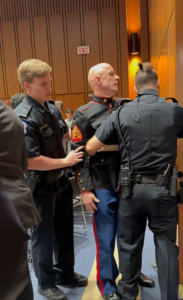
The dramatic confrontation has provoked intense national emotion: during a Senate Armed Services subcommittee hearing examining U.S. military readiness amid escalating involvement in the conflict with Iran, Montana Senator Tim Sheehy, a decorated former Navy SEAL, rose from his seat to assist three Capitol Police officers in physically removing a disruptive protester who had interrupted proceedings with a tearful anti-war declaration. The protester, identified as Brian McGinnis, a former Marine Corps member and Green Party Senate candidate from North Carolina, was forcibly ejected after clinging to a doorway and shouting that “America does not want to send its sons and daughters to war for Israel.” The incident left McGinnis injured—reports indicate a broken arm—and three officers requiring medical attention, resulting in his arrest on felony charges of assaulting police and resisting arrest.
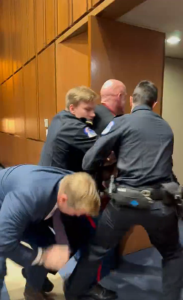
Emotions reached an overwhelming intensity as video footage captured McGinnis, still wearing his Marine Corps uniform, breaking into sobs while being dragged from the room. His outburst, delivered amid visible anguish, directly referenced personal loss: the deaths of his own sons in previous combat operations. The veteran’s raw grief transformed a formal legislative session into a visceral display of the human cost of war, compelling every person present—and millions watching subsequent footage—to confront the enduring pain carried by Gold Star families. The sight of a grieving father, once a disciplined Marine, reduced to tears and physical restraint inside the Capitol has evoked profound sorrow and outrage in equal measure, amplifying the sense that the nation’s war policies continue to exact an unbearable toll on those who have already sacrificed the most.
The controversy has escalated dramatically as the episode ignites fierce and deeply polarized debate. Supporters of McGinnis and broader anti-war voices condemn the response as disproportionate and emblematic of institutional intolerance toward dissent. They argue that a grieving veteran, exercising constitutionally protected speech in a public hearing, deserved verbal de-escalation and respect rather than physical force—particularly when the individual delivering that force was another combat veteran. They view Senator Sheehy’s intervention as an unnecessary escalation that silenced legitimate criticism of U.S. foreign policy at a moment of acute national consequence. Defenders of Sheehy and the security detail maintain that congressional hearings require order and decorum to function; McGinnis deliberately sought confrontation, physically resisted lawful commands, and placed officers in danger through his struggle. Sheehy stated afterward that his intent was to “de-escalate” the situation and prevent further injury, describing McGinnis as an “unhinged protestor” who arrived prepared for conflict. The divide has fueled exhaustive commentary across social media, broadcast networks, veteran organizations, and opinion platforms, with arguments centering on the boundaries of free expression in legislative settings, the propriety of senators participating in physical restraint, and the broader optics of one veteran confronting another in uniform.
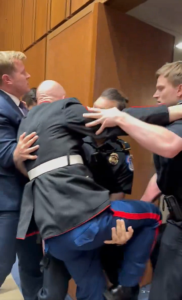
The precise sequence of events and immediate consequences remain charged with tension and partial disclosure. Capitol Police confirmed injuries sustained by McGinnis and three officers during the removal, along with the criminal charges filed. Video evidence shows McGinnis gripping the doorway frame, officers pulling him away, and bystanders shouting that his arm was being injured in the process. Senator Sheehy’s post-incident statement emphasized his desire to assist law enforcement and expressed hope that McGinnis receives appropriate care without causing additional harm. The hearing itself took place against the backdrop of intensifying U.S. military operations in the Middle East, including recent strikes inside Iran and a narrowly defeated Senate resolution seeking to limit presidential war powers without congressional approval—context that rendered McGinnis’s protest particularly pointed.
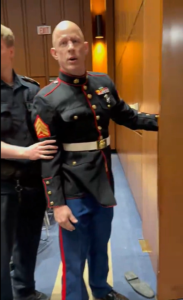
This forceful ejection underscores the volatile atmosphere enveloping congressional discussions of the Iran campaign. The presence of two military veterans—one a sitting senator who served in elite special operations, the other a former Marine openly grieving the loss of his sons—on opposing sides of the confrontation adds profound symbolic weight. It highlights the deep divisions within the veteran community over ongoing U.S. military engagements and the emotional scars that persist long after service ends. Whether the incident ultimately strengthens calls for stricter hearing protocols, galvanizes renewed anti-war activism, or prompts internal Senate reflection on managing dissent remains uncertain. For the present, it has crystallized the raw pain and unresolved anger that continue to surround America’s foreign wars.
This forceful ejection underscores the volatile atmosphere enveloping congressional discussions of the Iran campaign. The presence of two military veterans—one a sitting senator who served in elite special operations, the other a former Marine openly grieving the loss of his sons—on opposing sides of the confrontation adds profound symbolic weight. It highlights the deep divisions within the veteran community over ongoing U.S. military engagements and the emotional scars that persist long after service ends. Whether the incident ultimately strengthens calls for stricter hearing protocols, galvanizes renewed anti-war activism, or prompts internal Senate reflection on managing dissent remains uncertain. For the present, it has crystallized the raw pain and unresolved anger that continue to surround America’s foreign wars.
Leave a Reply