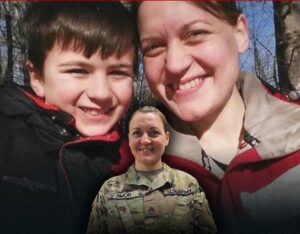
Just days before she was supposed to return home, U.S. Army Reserve Sgt. 1st Class Nicole Amor, a 39-year-old mother of two from White Bear Lake, Minnesota, was counting down the final moments of her deployment. Her family was doing the same. No one imagined that the clock would suddenly stop.
For months, Amor had been stationed overseas supporting U.S. operations in the Middle East. She served with the 103rd Sustainment Command, a logistics unit responsible for keeping troops supplied with food, equipment, and essential materials. It wasn’t glamorous work, but it was vital to the mission. Amor had been doing that job proudly for years.
To her children, though, she wasn’t a soldier.
She was simply Mom.
Back home in Minnesota, life had been moving slowly while they waited for her return. Her son, a high school senior, was preparing for graduation. Her daughter, still in elementary school, had been counting the days until she could finally hug her mother again. The family talked about all the things they would do once she came home—simple plans that suddenly felt very important.
In the final days of her deployment, Amor stayed in frequent contact with her husband. Their messages were ordinary, almost routine. They talked about work, about the kids, and about how exhausted she felt after long shifts.
During one conversation, she even joked about a small accident.
The night before, she had tripped and fallen while moving around the base. She laughed it off in messages to her husband, telling him she was fine and just tired. It was the kind of small, everyday story that couples share without thinking much about it.
Neither of them knew it would be one of the last things they would ever discuss.
A week before the attack, Amor and several other soldiers had been moved to a temporary structure near Port Shuaiba in Kuwait
But early on March 1, those fears became reality.
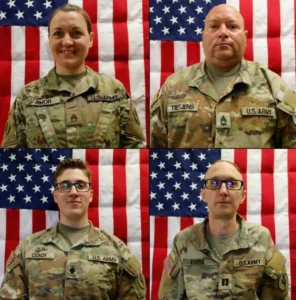
A drone strike hit the tactical operations center where Amor and other soldiers were stationed. The attack killed six American service members and marked the first U.S. military fatalities of the escalating conflict with Iran.
Back in Minnesota, the devastating news had not yet arrived.
Inside the Amor household, the children were still talking about their mother’s upcoming return. According to family members, they were excitedly planning the moment she would finally walk through the front door.
One of them said something simple.
Something completely innocent.
“Can you come home with me, Mom?”
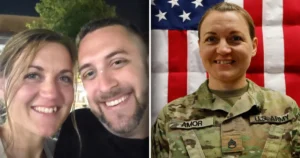
It was a child’s way of imagining the reunion—the drive home, the laughter, the feeling of finally having their mother back where she belonged.
But only hours later, military officials arrived with the news no family ever wants to hear.
The strike had taken her life.
The moment those words were spoken, the sentence their child had said earlier suddenly carried a completely different meaning. Family members would later say that the ordinary question now echoes painfully in their memories.
It wasn’t dramatic.
It wasn’t poetic.
It was just a child asking for their mom.
And that simplicity is what made it so heartbreaking.
Friends and relatives describe Nicole Amor as someone who lived two lives at once: a dedicated soldier and a deeply devoted mother.
At home, she loved gardening. She often spent weekends growing tomatoes and peppers in the backyard, turning them into homemade salsa with her son. She enjoyed rollerblading and riding bikes with her daughter on quiet neighborhood streets.
To her children, those moments defined her far more than any uniform or medal ever could.
But in the military community, Amor was equally respected.
She had enlisted in the National Guard in 2005 as an automated logistics specialist before transferring to the Army Reserve a year later. Over the years, she earned multiple commendations for her service and completed previous deployments to Kuwait and Iraq.
Colleagues remember her as calm, reliable, and fiercely protective of the soldiers she worked alongside.
“She answered the call to serve,” Minnesota officials said in tributes after her death, honoring the sacrifice she made for her country
But behind every uniform is a family.
And for the Amor family, the reality of that sacrifice arrived suddenly and brutally.
A mother who was supposed to be home in days never came back.
A husband lost the partner he had spoken to only hours before.
And two children were left holding onto memories—and a simple question that would never receive the answer they hoped for.
In wars, statistics often dominate the headlines: numbers of strikes, casualties, and strategic targets.
But behind every number is a story like this one.
A conversation that seemed ordinary.
A family waiting at home.
And the final words of a child who simply wanted their mother to come back.
Leave a Reply