Australia has officially introduced a groundbreaking law that restricts children under the age of 16 from accessing social media accounts, marking the first nationwide ban of its kind in the world. The law came into effect today and aims to address growing concerns about the impact of social media on young people’s mental health, safety, and well-being.
According to Australian authorities, the decision follows years of research and public debate linking excessive social media use among children and teenagers to anxiety, depression, low self-esteem, cyberbullying, and exposure to harmful content. The government argues that the digital environment has evolved faster than protections for minors, leaving many children vulnerable online.
Under the new law, social media platforms are required to take active steps to prevent users under 16 from creating or maintaining accounts. While the exact enforcement mechanisms will be phased in, platforms may face significant penalties if they fail to comply. Parents will also be encouraged to play a stronger role in monitoring their children’s online activity.
ABC correspondent Hanna Battah reports that supporters of the ban see it as a necessary intervention. “This is about giving kids time to grow without constant online pressure,” one advocate explained. “Childhood should not be dominated by likes, algorithms, and comparison.”
However, the law has also sparked strong criticism. Opponents argue that a blanket ban may oversimplify a complex issue. Mental health experts and digital rights groups warn that banning social media entirely could isolate some young people, particularly those who rely on online communities for support, identity, or connection—especially in remote or marginalized communities.
Critics also raise practical concerns about enforcement. They question how platforms will accurately verify users’ ages without creating new privacy risks, and whether tech-savvy teens will simply find ways around the restrictions. Some argue that education, digital literacy, and stronger content moderation might be more effective than an outright ban.
Despite the debate, Australia’s move is already attracting global attention. Several countries are closely watching the rollout of the law, considering whether similar measures could be adopted elsewhere. As governments worldwide grapple with how to protect children in an increasingly digital world, Australia’s decision could set a powerful precedent.
Whether the ban will significantly improve young people’s mental health remains to be seen. What is clear, however, is that the conversation around children, technology, and responsibility is far from over—and Australia has placed itself at the center of that global discussion.
An incredible $1 million has been raised for the hero bystander who tackled one of the alleged gunmen during the Bondi Beach terror attack.
At least 15 people have tragically died and dozens more have been injured as two gunmen opened fire on families gathered on Syndey’s Bondi Beach on Sunday (December 14) in what is now being declared a terrorist incident.
The horrific attack unfolded as more than 1,000 Jewish people came together to celebrate Hannukah.
A 10-year-old girl, a Holocaust survivor, a British Rabbi, a retired New South Wales police officer and a French national are among the victims who have been named so far.
The suspected gunmen, who stand accused of launching the deadliest attack on Australian soil in three decades, have since been identified as a father-and-son duo, Sajid Akram, 50, and Naveed, 24.
While Sajid was declared dead at the scene, Naveed is reportedly in critical condition in hospital.
Australian Prime Minister Anthony Albanese has since claimed the pair were acting alone and were not part of a wider cell, though they were ‘clearly’ motivated by extremism.
Despite the tragedy, Australia and the rest of the world have been eagerly awaiting to find out if an innocent civilian who took matters into his own hands by managing to disarm one of the gunmen amid the killing spree has recovered from his injuries.
Ahmad Al Ahmed’s heroic actions touched the world as he could be seen in a clip that has since gone viral, putting his own life at risk as he tackled the gunman.
Ahmed, who moved to Australia from Syria in 2006, was first spotted crouching down behind parked cars while the suspected shooter was spraying bullets with his back turned.
As screams could be heard ringing out in the nail-biting moment, Ahmed then jumped out from behind the cars and onto the back of the suspect, where he wrestled him in a tense tussle over the rifle.
Fortunately, Ahmed managed to seize the weapon, which he proceeded to point at the suspect.
The father-of-two has since been praised for his incredible act of courage, which probably saved countless more lives as people fled the beach.
A fundraiser for the 43-year-old Sydney fruit shop owner has since raised more than $1 million, and is inching closer to far surpassing that amount as the minutes go by.
Billionaire Bill Ackman, a Jewish investment banker, is said to have donated $99,000 in the GoFundMe.
The GoFundMe set up to ‘show our gratitude and support’ for the father reads: “After witnessing the extraordinary actions of the hero who helped disarm one of the attackers during the Bondi tragedy, an act that prevented the loss of countless more lives, we felt compelled to act.
“In a moment of chaos and danger, he stepped forward without hesitation. His actions were selfless, instinctive, and undeniably heroic, taken without regard for his own safety. Early reports indicate he was shot twice in the process while protecting others.”
Ahmed’s family has confirmed he was injured in the attack, sustaining gunshot wounds to his arm and hand, though fortunately, he appears to be on the mend.
His cousin, Mustafa, told 7News Australia: “He is a hero, 100 percent he is a hero. He has two shots, one in his arm and one in his hand.”
In an update today, he added: “I hope he will be fine. I saw him last night. He was alright but we’re waiting to see what the doctor (says).”
His father added: “When he did what he did, he wasn’t thinking about the background of the people he’s saving, the people dying in the street. He doesn’t discriminate between one nationality and another. Especially here in Australia, there’s no difference between one citizen and another.”
New South Wales Premier Chris Minns has also visited Ahmed in hospital, writing on Twitter: “Ahmed is a real-life hero. Last night, his incredible bravery no doubt saved countless lives when he disarmed a terrorist at enormous personal risk.
“It was an honour to spend time with him just now and to pass on the thanks of people across NSW.
“There is no doubt that more lives would have been lost if not for Ahmed’s selfless courage.”
At approximately 18.47pm local time today (Sunday, December 14), New South Wales police responded to reports of gunfire at the popular Australian beach where more than 1,000 people were celebrating the Jewish holiday, Hanukkah.
Cops have now confirmed 12 people have died, including one alleged gunman. Another suspect remains in critical condition while dozens more, at least 29 at the time of writing, including a child and two officers, have been taken to hospital for treatment.
The horrific incident in Sydney has since been declared a terrorist attack and now stands as the deadliest shooting in the country since the Port Arthur massacre in 1996.
Now, social media is flooded with footage of the incident from witnesses and bystanders, including terrifying moments the suspected shooters took cover from a bridge leading to the beach to open fire at civilians.
Other footage shows how panic broke out, with hundreds fleeing from the scene and the vicinity.
Meanwhile, another viral clip shows one civilian appearing to take matters into his own hands, who has since been applauded around the world for his courageous quick-thinking act that may have saved countless innocent lives.
The incredible footage shows the man, wearing a light t-shirt and black trousers, crouching behind a parked car while the alleged suspect could be seen shooting his firearm with his back turned.
Seconds later, the brave bystander is seen creeping behind the suspect before jumping up to throw his arms around him, where he grappled him to the floor in the incredibly heroic attempt to disarm him.
There’s a tense moment as the shooter still appears in possession of the weapon until the civilian manages to wrestle it free.
As the suspect scrambles to his feet, the bystander is seen pointing the weapon at the suspect as he promptly retreats. The hero then gently places the weapon down against a tree where he proceeds to take cover.
While the sound of gunshots could be heard ringing out in the background throughout, the video then pans to the other suspect, apparently still firing at people from the vantage point on the bridge.
As it does, it captures what appears to be another bystander running into frame to throw an object at the now disarmed and retreating shooter.
The second shooter also appears to be returning fire somewhere before a flying bullet hits the side of the bridge near his position.
The footage then pans back to the two civilians, now crouched behind a tree. The man who threw the object could be seen reaching for the weapon before grabbing his wrist, apparently injured.
Cops then can be seen approaching the man on the bridge where they apparently go on to ‘neutralise’ the threat.
The man who disarmed the suspect has since been identified as father-of-two, Ahmed Al Ahmed, who reportedly owns a fruit shop.
His cousin, who spoke to 7News Australia, says the 43-year-old has no experience using a weapon and is in hospital receiving treatment for two gunshot wounds in his arm and shoulder.
Premier Chris Minns is one of many celebrating Ahmed, saying in a statement: “That man is a genuine hero, and I’ve got no doubt there are many, many people alive tonight as a result of his bravery.”
In an update, cops also confirmed a bomb disposal unit has been deployed after discovering a vehicle which may contain several improvised explosives.
Australia’s Prime Minister Anthony Albanese said in a news briefing: “An act of evil antisemitism, terrorism that has struck the heart of our nation.”
Albanese said the attack on the Jewish community took place on a day that should have been a ‘day of joy,’ adding that there’s no place for this ‘vile act of violence and hate’.
There are moments in war that never make the headlines.
No speeches.
No flags.
No victory music.
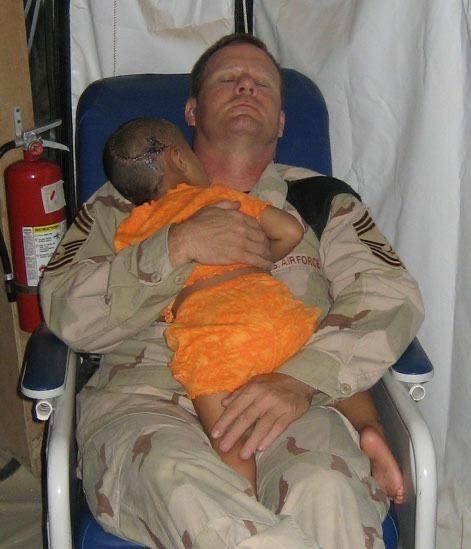
Just a chair, a tired man in uniform, and a child who should not be alive.
Chief Master Sgt. John Gebhardt was already exhausted. The kind of exhaustion that settles into the bones after too many nights without sleep, too many scenes the mind refuses to forget. Iraq was loud by day and louder by night — helicopters, alarms, distant explosions — but inside the medical tent, the noise faded into something else entirely: breathing, crying, and the quiet urgency of survival.
That was where she came to him.
She was tiny. Much too small to understand what had happened to her world. Insurgents had stormed her family’s home. Her parents were executed. Her siblings were killed. And then, as if mercy had briefly hesitated, a bullet struck her head — meant to end her life too.
It didn’t.
She arrived at the hospital wrapped in blood-soaked cloth, her body trembling, her cries sharp and relentless. Surgeons worked quickly. Nurses moved with practiced urgency. Against all odds, the infant survived.
But surviving was not the same as being at peace.
Night after night, she cried. She moaned. She startled awake as if still hearing the gunfire. No amount of medicine or gentle rocking seemed to help. The nurses tried everything — and then they noticed something strange.
When John held her, she calmed.
Not instantly. Not magically. But enough. Enough to breathe slower. Enough to rest her head against his chest. Enough to sleep.
So John stayed.
He didn’t have to. No one ordered him to. There was no protocol for this. But every night, when the lights dimmed and the hospital settled into that fragile quiet only war hospitals know, John sat down in a simple chair, cradled the injured child in his arms, and slept there with her.
Four nights in a row.
No bed. No relief. Just a chair and a promise his heart made before his mind could stop it: You will not be alone.
The nurses watched it happen again and again. They whispered about it. They said he was the only one who could calm her. That the moment she felt his arms around her, the crying eased. As if her body recognized safety before her mind ever could.
John didn’t speak about it. He didn’t see himself as a hero. He was a father back home. He knew what it meant to hold a child who trusted you completely — and he knew what it meant to imagine losing one.
So he held her.
The uniform he wore that night was not a symbol of power. It was stained with dust, sweat, and the weight of too many losses. But to that child, it was something else entirely.
It was warmth. It was steadiness. It was life.
His wife, Mindy, later explained what few people knew at the time: this little girl had lost everyone. She had entered the world of memory without a single familiar face left. And yet, in the middle of war, she found arms that refused to let go.
Each night, John slept lightly, instinctively adjusting when she shifted, tightening his hold when she whimpered. He woke when she cried. He stayed when others rotated out. There were no cameras then. No speeches. Just a man doing what felt necessary.
She is healing now.
Slowly. Painfully. But she is alive.
And that matters.
Some will argue endlessly about war — about politics, strategy, mistakes, and motives. Those arguments have their place. But they cannot erase this moment.
A moment where compassion crossed borders. Where humanity stood taller than violence. Where a child, meant to be erased, was instead protected.
John Gebhardt will likely never call himself a hero.
People like him rarely do. But heroism is not always loud. Sometimes it looks like a man asleep in a chair, holding a child who has no one else left in the world.
If you ever wonder whether kindness still survives in the darkest places – remember this.
Remember that even in war, there are moments that save more than lives.
They save hope.
And sometimes, that hope fits perfectly into the arms of someone who refuses to let it fall.
The crash was reported just after 9:30 p.m. Friday on Terra Bella Street and Woodman Avenue.
A speeding westbound gray Plymouth minivan on Terra Bella Street failed to stop for a red light and struck a blue Ford Mustang and tan Honda Civic that were both going southbound on Woodman, according to an LAPD statement.
“Investigators believe the driver of the minivan was fleeing the scene of an unrelated collision prior to this crash,” the statement said. “Following the collision, the driver of the Honda Civic exited the vehicle and fled the scene, failing to stop, identify themselves, and render aid as required by law.”
Adrian Carrillo, an active Marine, and his girlfriend were in the Mustang, according to a family member. They both died at the scene. The driver of the minivan was also killed and a passenger in the van remains hospitalized in critical condition.
“He was like the brother I never ever had,” said Carrillo’s cousin, Juan Bautista. “I just loved him so much. He was such a good person. He dedicated himself to God. He took care of his parents so much.”
Eyewitness News spoke with Bautista Saturday at the crash site as he visited a growing memorial filled with flowers and candles.
“It just pisses me off,” said Bautista. “I’m mad that this happened to my cousin. Very young. 26 years old.”
Now, some people who drive throughout Panorama City say they’re heartbroken and concerned.
“You hear about accidents all over the world, but once you’re there in that radius, it’s like, ‘Ok. It could happen to me. It could happen to somebody I know,” said one neighbor.
“I’m literally about to tear up right now, but rest in peace to those souls,” said Sebastian Porras, another neighbor. “I really hope that people can really understand to just drive safely. Our lives are so important, and anything can happen within seconds.”
Some say many drivers don’t use caution at that particular intersection.
“At least like once or twice a month, there’s an accident.,” said neighbor Anissa Avelar.
Bautista and his family are now left dealing with a tragedy so close to Christmas.
“I had so many things planned so we could just hang out,” said Bautista. “Adrian, I’m going to miss you so much. You’re always going to be in my heart … always, always.”
Police said the crash serves as a reminder to stay at the scene of a crash if you’re involved until help arrives.
Meantime, investigators are still searching for the driver of the Civic who left their car.
Anyone with information regarding the crash is being asked to call the LAPD’s Valley Traffic Division at (818) 644-8116 or (818) 644-8020. Calls during non-business hours or on weekends can be directed to (877) 527-3247. Callers who wish to remain anonymous can call Crime Stoppers at (800) 222-8477 or visit lacrimestoppers.org.
Before you meet him, the first thing you’ll hear is the nickname.
“Cyborg.”
It sounds like a character from a comic book — a superhero name, not a label for a boy born with a rare bone condition. But once you see the way he walks, the light in his eyes, and the quiet determination in his voice, you understand. He earned it.
This is the story of Mateus, a boy told his body would never be “normal.” But instead of giving up, he chose to rebuild it — stronger, better, more resilient.
From the start, Mateus faced a diagnosis that would shake any family. He was born with a rare condition affecting one in a million children: congenital short femur combined with limb hemimelia. One leg significantly shorter than the other, a tilted hip, a challenging gait — every step was a test.
Doctors explained gently but honestly. He would need multiple surgeries. Years of physical therapy awaited. Even then, they warned, he might never walk “normally.”
But what no medical record could predict was Mateus’ spirit.
From the very beginning, Mateus refused to see himself as limited. He gave himself a nickname, a symbol of his journey — not broken, but rebuilt.
“Cyborg.”
It started as a quiet joke whispered between nurses and his parents after his first major surgery. Soon, it became his identity — a badge of courage, resilience, and transformation.
Every time surgeons adjusted the metal frames or tightened the rods used to lengthen his leg, Mateus would grin.
“See? Half metal, half me. I’m stronger now,” he would say.
And somehow, his optimism spread to everyone around him.
The science behind his recovery is remarkable. Mateus underwent a process called bone lengthening, a sophisticated procedure in modern orthopedics that is both science and miracle.
Surgeons carefully break the bone in a controlled way, attach an external fixator, and slowly stretch the bone over months, millimeter by millimeter. The body responds by creating new bone in the gap — growing bone from nothing.
The process is agonizing, physically and mentally. Every day the screws are turned. Muscles stretch painfully. Physical therapy pushes the limits of human endurance.
Yet Mateus fights through it all.
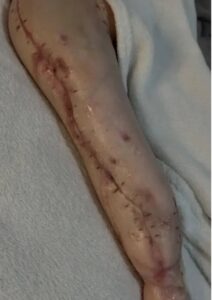
So far, he has completed two bone-lengthening surgeries, extending his affected leg by more than 10 centimeters — nearly four inches.
That number alone doesn’t capture the years of pain, the months spent in the hospital, and the countless nights his mother held him through the tears of aching bones and joints.
But ask him about it, and he shrugs.
“It hurt,” he says with a wide grin, “but it was worth it.”
Now, the treatment pauses briefly. Each phase of bone lengthening requires time for recovery — for bones to solidify, for muscles and joints to adapt, and for a growing body to catch up.
The plan is clear: Every two years, another lengthening until growth completes. If all goes well, by 2027, Mateus’ legs will be equal in length.
That means at least two more surgeries — possibly three. Weeks in the hospital, months of rehabilitation, and extraordinary patience. Most adults would crumble under such a schedule.
Mateus sees it as a challenge.
“When the next phase comes,” he says, “I’ll be ready.”
If you walk into the hospital where he is treated, you’ll see his name at the corner of a large whiteboard — underlined twice, with a smiling face beside it.
The nurses call him “our little warrior.”
He shakes hands with everyone in the hall, jokes with surgeons, and reminds other children that scars aren’t ugly — they are proof of survival.
During one physical therapy session, a small boy cried from the pain of stretching exercises. Mateus rolled up his pants to reveal scars and pin marks along his thigh.
“Look,” he said, “these hurt too. But they help me run faster.”
The child stopped crying.
That is his influence — turning fear into courage just by being himself.
The head nurse, who has followed Mateus’ case from the beginning, speaks with pride bordering on awe.
“He is not just a patient,” she says. “He shows that medicine is not just science, it’s heart.”
She remembers seeing his X-rays for the first time — a short, curved femur, misaligned hip. The prognosis was grim. But each return visit told a different story — bones growing where they shouldn’t, strength developing where there was weakness.
On her desk, she keeps the latest medical summary. It reads like a record of miracles:
“Congenital short femur with limb hemimelia. Two bone-lengthening surgeries completed. Gained over 10 cm. Fully mobile during recovery. Prognosis: Excellent.”
Beneath it, in her handwriting, she adds a note:
“The boy refuses to stop growing.”
For Mateus’ mother, the hardest part is not the surgeries, but the waiting.
Waiting between phases. Waiting to see if the new bone holds. Waiting for the day he can run without limping, without braces, without pain.
At home, every victory is celebrated — each extra centimeter, each step forward, each night he sleeps pain-free. The refrigerator is covered in drawings and X-rays, each dated like milestones on a map.
Most prominent: a bold phrase —
“Strong like Cyborg.”
What makes Mateus extraordinary is not just his medical condition, but his mindset.
He does not see disability as limitation. He sees it as transformation.
When he talks about his leg, he never says “weak leg” or “injured leg.” He says, “strong leg.” Rebuilt. Fighting. Resilient.
He dreams of one day becoming a physical therapist — or maybe an engineer designing medical devices for children like him.
“I want to help other cyborgs,” he says with a wink.
Because that’s what he believes about them — children with metal, scars, and stories that make them unique, not broken.
Doctors predict that when Mateus matures, his legs will be nearly equal. No braces, no orthopedic shoes, no more surgeries.
But his legacy goes beyond medicine.
He inspires other children with similar conditions to believe their lives are not over because of a diagnosis. He teaches families and even doctors what true perseverance looks like. And perhaps most importantly, he reminds everyone that resilience is not something you are born with — it is something you build, piece by piece, through pain and determination.
When asked about his nickname “Cyborg,” his mother smiles.
“He gave it to himself,” she says. “He said if his bones are made stronger with metal, he’s part superhero now.”
And in a way, he is right.
Every surgery makes him stronger, not weaker. Every scar tells a story of pain, but also of strength.
Because Mateus is not just learning to walk straight. He is teaching the world that perfection isn’t symmetry — it’s endurance.
Strength isn’t having equal legs. It’s standing tall no matter how many times you fall.
The human body may be fragile, but the human spirit? Unbreakable.
By 2027, when the next phase begins, Mateus will face months of pain, patience, and perseverance again.
But if his story so far is any indication, he will meet it as he always has — brave, smiling, and lighting up the hospital room.
When asked what he looks forward to most, his answer is simple:
“To run — really run — with both legs equally.”
And when that day comes, the world will see what his family and doctors already know:
He was never broken. He is being rebuilt.
Because sometimes, heroes aren’t born with capes or in comic books. Sometimes, they are made — surgery by surgery, scar by scar, miracle by miracle.
In the quiet moments of everyday life, it’s easy to overlook the subtle beauty that surrounds us.
A gentle breeze rustling through the leaves, the melodic chirping of birds, or the dappled sunlight filtering through a tree canopy often goes unnoticed, drowned out by the demands of our fast-paced world.
Yet, sometimes, in the unlikeliest of instances, a seemingly ordinary scene can transform into a breathtaking spectacle, reminding us of the magic inherent in life’s small details.
Recently, a man captured such a moment while filming a solitary tree and its peaceful surroundings.
Armed with nothing more than a camera and an appreciation for nature, he sought only to preserve a slice of tranquility—a simple video of leaves, branches, and the occasional bird perching.
At first glance, the footage appeared entirely ordinary: a tree standing serenely in its environment, birds fluttering gently between branches, and the soft interplay of light and shadow that so often goes unnoticed.
Yet, as any nature enthusiast knows, even in the quietest moments, nature is alive with activity.
Birds chirp in dialogue with one another, insects weave invisible paths through the air, and light shifts imperceptibly as the sun moves across the sky.
Capturing this intricate choreography on film requires patience, timing, and an appreciation for the subtle rhythms of the natural world.
Our videographer, likely unaware of what was about to unfold, positioned his camera with the intention of documenting the ordinary, yet beautiful, interplay of life around him.
The Calm Before the Extraordinary
For the first seventeen seconds, the video conveys an almost meditative calm. Birds flit gracefully between branches, their wings catching the sunlight at just the right angle to shimmer briefly in the lens.
A gentle breeze rustles the leaves, creating a soft, rhythmic sound that seems almost musical. This initial segment exemplifies the quiet beauty that so often goes unnoticed:
it is a slice of time in which nature performs its usual, unremarkable, and yet endlessly captivating routines.
At this stage, a casual observer might dismiss the footage as simply “pleasant” or “nice to watch,” appreciating it as background visual for a relaxing moment. But therein lies the first lesson of this extraordinary video: beauty often exists in the unremarkable, waiting for our attention to recognize it.
The Moment of Transformation at 0:18
Then, precisely at 0:18, the video takes an unexpected turn. Something extraordinary occurs—a moment so fleeting and unplanned that it transforms the mundane into the magical.
In a world where we are constantly seeking curated experiences and planned spectacles, this sudden and unpredictable burst of movement or light feels astonishing.
It reminds viewers that the most profound experiences are often not staged; they emerge from the intersection of patience, observation, and pure chance.
What makes this moment so captivating is its unpredictability. The videographer did not manipulate the scene, no special effects were employed, and no external intervention created the magic.
Instead, the scene’s unique combination of elements—a robust tree, a scattering of birds, and the timing of light and shadow—conspired to produce a brief, mesmerizing event that could not be replicated. Such moments are rare, and their fleeting nature only heightens their impact.
It’s impossible to fully describe the effect of this singular instant without seeing it unfold. Perhaps a sudden alignment of sunlight through the leaves illuminated a flock of birds in such a way that it created an ethereal glow.
Perhaps the birds themselves synchronized in an unexpected pattern, moving in a way that resembled choreography.
Or perhaps an element of reflection or shadow momentarily played across the scene, producing a visual phenomenon that felt almost supernatural. Whatever the exact cause, the result is undeniable: a moment that commands attention and sparks wonder.
The Role of Timing and Patience
Moments like these are rarely engineered. They rely on the patient observer, someone willing to remain still and attentive to the rhythms of the natural world.
Capturing this instance on film required the man to spend hours—or perhaps days—immersed in the environment, attuned to subtle cues: the flight paths of the birds, the shifting sunlight, the movement of leaves in the wind.
Photography and videography of nature often operate at the intersection of science and art. Observers study animal behavior to anticipate actions, yet the natural world retains a degree of randomness that can never be fully predicted.
In this sense, the video at 0:18 exemplifies the power of serendipity in nature: a confluence of environmental factors and natural behavior that creates an unforeseen spectacle.
This unpredictability is what sets the extraordinary apart from the ordinary.
Viewers might watch a tree swaying in the wind hundreds of times without noticing anything remarkable, yet a single instance of perfect timing—like the one captured here—can transform an otherwise normal scene into a source of awe and reflection.
A Study in Light, Movement, and Composition
From a technical perspective, the video is compelling not only for its narrative of chance but also for its aesthetic qualities.
The placement of the tree, the spacing of its branches, and the surrounding flora create a natural frame that draws the eye.
The birds, in motion or at rest, provide dynamic contrast against the stationary background, while the interplay of light and shadow adds depth and dimensionality to the scene.
At 0:18, all these elements converge. A flash of sunlight may catch a particular leaf, illuminating a bird in mid-flight, or the reflection off a nearby surface could create a radiant effect.
The camera, stationary or subtly panning, captures these coincidences with perfect clarity. In this sense, the video functions both as a documentary of a natural event and as a work of art, demonstrating the inherent beauty of composition, timing, and observation.
The Psychological Impact of Unplanned Wonder
Part of what makes this video so affecting is its emotional resonance. Humans are drawn to moments of surprise and unpredictability; when we encounter an unplanned event that is beautiful or awe-inspiring, it stimulates a sense of wonder.
Studies in psychology suggest that observing rare or unexpected phenomena can activate the brain’s reward centers, releasing dopamine and fostering feelings of joy and curiosity.
In practical terms, viewers of this video may experience a sudden sense of delight, a reminder that life is full of unanticipated beauty.
The moment at 0:18 serves as a microcosm of the broader principle that even in familiar surroundings, extraordinary experiences can arise.
It underscores the idea that paying attention to the world around us can reveal moments of profound significancethat would otherwise go unnoticed.
The Mystery Behind the Moment
One of the reasons this video has captivated audiences is the mystery of its occurrence. Was the sudden flash of movement or light the result of a rare natural phenomenon, such as the fleeting alignment of sunlight with the leaves and birds?
Could it have been an optical effect created by lens flare or reflection? Or was it simply the unpredictable choreography of wildlife coinciding with perfect environmental conditions?
The video invites speculation, discussion, and repeated viewings. Each replay reveals new subtleties—perhaps a previously unnoticed wingbeat, a shifting shadow, or the slight shimmer of dew reflecting the sun.
In this way, the footage functions almost like a puzzle, rewarding careful attention and contemplation.
Life Lessons From an Ordinary Tree
Beyond its visual appeal, the video conveys a broader philosophical message. It reminds us that extraordinary moments are often hidden within the ordinary.
Just as the man’s simple recording of a tree captured an unexpected burst of wonder, our everyday lives contain potential moments of magic waiting to be noticed.
Patience, attentiveness, and mindfulness can transform mundane experiences into sources of inspiration.
Furthermore, the footage illustrates the interconnectedness of natural systems. The tree provides shelter for the birds, the birds’ movement interacts with sunlight, and the resulting visual spectacle emerges from the harmonious—or sometimes chaotic—interaction of living and nonliving elements.
This interplay highlights the complexity and beauty of ecological relationships, encouraging viewers to appreciate the delicate balance inherent in natural environments.
Why the Video Resonates
Audiences are drawn to this video not simply because of its aesthetic quality but because it captures a moment that could never be repeated exactly. In an age dominated by digital media, where experiences are often curated, filtered, or scripted, there is profound appeal in witnessing something spontaneous and real.
The unpredictability of the moment at 0:18 gives it authenticity, reminding viewers that the natural world is full of surprises that no human hand can fabricate.
Moreover, the video encourages reflection. Observers may consider how often they overlook subtle beauty in their surroundings, or how rarely they pause to witness the simple, yet remarkable, events unfolding daily in nature.
In this sense, the video is more than a recording; it is an invitation to cultivate mindfulness, presence, and appreciation for life’s fleeting wonders.
Sharing the Moment With Others
The man who filmed the video did not intend to create viral content; he simply wanted to capture a peaceful scene. Yet, through sharing the footage, the magical moment at 0:18 has now reached a wider audience, inspiring viewers around the world.
Comments often reflect amazement, curiosity, and a renewed sense of wonder. Some viewers speculate about the precise cause of the unexpected visual, while others simply appreciate the beauty and serenity of the overall scene.
The video serves as a reminder that sometimes, the most impactful experiences are not the ones we plan, but the ones we encounter unexpectedly.
It encourages people to slow down, observe, and cherish the ordinary, because hidden within the ordinary may lie moments of profound and unforgettable beauty.
Conclusion: The Power of Unexpected Beauty
In conclusion, what began as a simple recording of a tree and its surrounding wildlife transformed into a powerful reminder of life’s unpredictability and beauty.
At 0:18, an unplanned burst of movement or light elevated the scene from ordinary to extraordinary, captivating viewers and inspiring reflection on the subtle wonders present in our everyday world.
This video demonstrates several enduring truths:
Patience and observation can reveal moments of beauty in ordinary environments.
Unpredictable phenomena can produce experiences that feel magical or awe-inspiring.
Mindfulness and attentiveness allow us to fully appreciate fleeting moments that might otherwise go unnoticed.
Even the most ordinary natural elements—a tree, a few birds, shifting light—can combine to create a spectacle of wonder that resonates deeply with viewers.
Ultimately, this video is a celebration of nature, timing, and serendipity. It reminds us that extraordinary beauty does not require grandeur or planning; it often emerges spontaneously, in the quiet, overlooked corners of the world.
By taking the time to watch, listen, and notice, anyone can encounter such moments—an ever-present invitation to experience the magic that exists all around us.
A Sydney father-of-two is being praised as a hero after risking his life to take down a gunman during a horrifying mass shooting at Bondi Beach.
Ahmed al Ahmed, 43, owns a fruit shop in Sutherland and had no experience with firearms when he stepped into the line of fire.
But that didn’t stop him from leaping into action in what’s now being called an act of incredible bravery.
Ahmed was shot twice during the confrontation and is currently recovering in hospital after undergoing surgery.
“He’s in hospital and we don’t know exactly what’s going on inside,” his cousin Mustafa told 7News.
“We do hope he will be fine. He’s a hero 100 per cent.”
Caught in the chaos, Ahmed made a split-second decision
Footage captured the moment Ahmed, dressed in a white shirt, crouched behind a car in a Bondi Beach carpark just metres from one of the shooters.
As gunfire erupted, he waited for the right moment, then sprinted through the parked cars and grabbed the shooter in a headlock from behind.
The struggle lasted around five seconds before Ahmed successfully wrestled the gun away. The gunman stumbled back, and Ahmed pointed the weapon at him as he backed off toward a nearby bridge.
Video later showed Ahmed sitting on the ground with a visible leg injury while bystanders rushed to help. One man brought over a towel to stem the bleeding, and responders were seen supporting him from behind.
Despite being wounded, Ahmed managed to place the gun safely against a tree.
Second shooter killed as gunfire exchanges with police
The second gunman, seen on the raised bridge nearby, was ducking and firing at police as he gestured wildly for his disarmed partner to return, per News.com.au.
Ahmed, still crouched by the tree, was joined by another man who was then shot as the chaos unfolded.
Soon after, an officer flanked the bridge and fired at the second shooter, killing him on the spot. The surviving gunman was taken into custody with injuries.
Additional footage showed police performing CPR on the fatally shot attacker while others treated the second suspect.
Another disturbing video showed police helping two injured men on the ground. A shotgun lay beneath one of them alongside multiple spent shells.
The tragic scene unfolded on Bondi Beach. Credit: George Chan / Getty
Tragedy strikes Jewish celebration at Bondi Beach
The shooting took place during a Jewish celebration called Chanukah By The Sea.
A brochure invited people to gather at Bondi Beach Park near the children’s playground at 5:00PM.
The beach was also packed due to the Bondi Christmas markets.
In total, 12 people are dead – including one of the gunmen – and 29 are in hospital following what authorities believe was a targeted attack.
NSW Police issued a statement at 9pm on Sunday: “A police operation is ongoing after a public place shooting by two men at Bondi Beach earlier today.
“Ten people have been confirmed dead, including a man believed to be one of the shooters. The second alleged shooter is in a critical condition.
“At this time, a further 11 people are reported to be injured, two of which are police officers.
“Emergency services were called to Campbell Parade about 6.45pm (Sunday 14 December 2025), responding to reports of shots being fired.
“Officers attached to Eastern Suburbs Police Area Command attended assisted by multiple resources across the city.
“A number of suspicious items located in the vicinity are being examined by specialist officers and an exclusion zone is in place.
“A multi-agency response is continuing.
“An extensive crime scene has been established and inquiries are now underway. There have been NO reports of any other incidents in Sydney connected to this incident.
“Police are now appealing for anyone with mobile phone vision or dashcam vision relevant to this incident to contact Crime Stoppers on 1800 333 000.”
Sydney is reeling after one of the deadliest attacks in Australia’s recent history. What began as a peaceful Jewish community celebration at Bondi Beach turned into a night of terror, leaving at least 12 people dead and dozens more injured, according to authorities 9News +1.
The attack, which unfolded shortly before 7 p.m. local time, targeted a Hanukkah event known as “Chanukah By The Sea.” Families, children, and elders had gathered to celebrate the holiday when gunfire erupted without warning.
A Coordinated Assault
Police say two gunmen opened fire from a nearby bridge overlooking the event, sending hundreds of people running for their lives 9News +1.
Authorities later discovered improvised explosives in a vehicle linked to one of the shooters, raising fears that the attack could have been even more devastating 9News.
Chaos, Courage, and Heartbreak
Eyewitnesses described scenes of “pandemonium” as bullets tore through the crowd 9News +1.
Among the victims was a local rabbi, a beloved figure in the community whose presence had always symbolized unity and peace 9News.
A Targeted Act of Hate
Australian officials have declared the attack a terrorist incident, emphasizing that the shooters deliberately targeted the Jewish community TIME +2.
Prime Minister and state leaders condemned the attack as “vile,” urging the nation to stand together against hatred and extremism.
A Nation in Mourning
As the sun rose over Bondi Beach the next morning, flowers, candles, and handwritten notes began to appear along the shoreline. The community gathered not just to grieve, but to show resilience — a message that violence will not divide them.
Hospitals across Sydney continue to treat the 29 injured survivors, including children 9News. Police remain on high alert as investigations continue into the attackers’ motives and possible connections.
A Moment That Will Not Be Forgotten
The Bondi Beach attack has left deep scars on a city known for its openness and diversity. But in the midst of tragedy, stories of bravery, compassion, and unity have emerged — reminders that even in the darkest moments, humanity refuses to break.
Australia now faces difficult questions about security, extremism, and the safety of minority communities. But one thing is clear: the people of Sydney are standing together, determined to honor the victims and support the families shattered by this senseless act of violence.
The day was supposed to be simple, joyful, and full of laughter — a celebration wrapped in balloons, bright colors, and the excited squeals of children running through an indoor adventure park.
It was her sister’s birthday.
A moment meant for cake. For candles. For wishes whispered with eyes closed tight.
And six-year-old Emma Riddle — bursting with the pure, unfiltered joy only children possess — was there to celebrate with all the enthusiasm her tiny heart could hold.
But in the span of a single instant, the world shifted.
In the span of a single collision, a family’s life broke open.
And the night that should have ended with presents and photographs instead ended with a desperate 911 call, flashing red lights, and the sound of a helicopter cutting through the Florida sky.
THE RIDE THAT SHOULD HAVE BEEN SAFE
Urban Air Adventure Park was alive that evening — a whirl of neon lights, arcade beeps, climbing walls, and the hum of go-karts weaving along the track.
Emma was riding in a kart with an adult, strapped in, smiling, waving to her family every time she passed them.
She looked small in the seat, her legs barely long enough to bend comfortably, but her joy was enormous — a joy so bright it seemed to color everything around her.
Then, suddenly, another kart sped toward them.
Witnesses recall a sickening moment — a blur of movement, a screech of impact, a hollow thud that echoed in the enclosed space.
Two karts collided.
And in that single collision, in that single violent instant, a birthday celebration became a tragedy.
THE CALL FOR HELP
At 8:50 PM, the call went out.
Park staff dialed 911, their voices trembling, urgency rising behind every word.
Paramedics from the St. Lucie County Fire District rushed in, their equipment clattering, their faces set in grim concentration.
Emma lay still.
Too still.
Her tiny body, so full of life just moments earlier, was now fighting for breath, fighting for strength, fighting for time — a battle no child should ever have to fight.
Rescue teams worked over her with gentle hands and frantic hearts.
And then, with no time to waste, she was airlifted — lifted into the night through spinning helicopter blades — toward the hospital that would become her final stop on this earth.
Her family followed by car, driving through the darkness with their hearts breaking open, praying for a miracle that refused to come.
THE DAY THE WORLD LOST EMMA
By the next day, hope had thinned.
Doctors did everything — absolutely everything — that modern medicine allows.
But Emma’s injuries were too severe, too overwhelming for her little body.
And as the sun rose over Florida, a family received the words that no parent, no sibling, no grandparent should ever hear:
Emma was gone.
Six years old. Full of light. Full of laughter. Full of the kind of love that makes the world feel softer.
Gone.
A CHILD REMEMBERED AS SUNSHINE
Her obituary — written through tears, carried by shaking hands — became a final love letter to the little girl who changed every life she touched.
Her family wrote that Emma was “full of life, love, and light,” that she “touched every soul she met,” that she was “joyfully celebrating her sister’s birthday” when the unthinkable happened.
They described a child with a radiant spirit — a child who adored God, a child whose faith was strong, a child whose kindness seemed too immense for such a small frame.
“Though her time with us was far too short, Emma filled every moment with laughter, compassion, and warmth,” the obituary reads.
“She will forever remain a precious daughter, sister, friend, and a cherished gift from God.”
And those words — soft, reverent, trembling with heartbreak — now stand as a testament to a light extinguished too soon.
A PARK CLOSED, AND QUESTIONS LOOMING
Urban Air Adventure Park shut its doors the moment the news broke.
What had gone wrong?
How could a place built for joy become the setting for such devastation?
On Monday, a state inspector from the Florida Department of Agriculture and Consumer Services, which oversees amusement ride safety, entered the facility with a clipboard in hand and a seriousness that filled the room.
Investigators now pore over every detail: the maintenance logs, the track layout, the kart mechanisms, the training received by staff, the emergency response procedures — all in an attempt to understand the chain of failures that led to a child’s death.
Why did the collision occur? Was it speed? Was it mechanical fault? Was it human error? Was it preventable?
These are not just technical questions. They are moral ones.
Because behind every answer lies another family — another parent — who just wants to know that parks built for joy will not become places of tragedy.
A HEARTBROKEN COMMUNITY GATHERS AROUND THE FAMILY
In the days following Emma’s passing, the community did what shocked communities often do:
They gathered.
They prayed.
They cried with people they didn’t know.
They lit candles.
They left flowers at the entrance of the closed entertainment park, transforming a place once filled with laughter into a silent shrine of grief.
A GoFundMe was created — not just to ease the financial burden, but to give people a way to say:
“We see your pain.” “We grieve with you.” “Emma mattered.”
And she did.
To everyone.
Even those who never met her.
THE UNSPOKEN PAIN OF A FAMILY FOREVER CHANGED
The hardest part of any tragedy involving a child is the silence that follows.
The toys left untouched.
The empty bed.
The birthday balloons that still hang in corners, now reminders of a day that can never be celebrated again.
A family does not ever “move on” from something like this.
They learn to move with it — with the weight, with the memories, with the longing for a little girl whose laughter once danced through their home like sunlight on walls.
And tonight, as investigators continue their work, as the park remains closed, as the community mourns, one truth rises above everything else:
Emma’s life was short, yes — heartbreakingly short — but it was bright.
It was meaningful.
It was full of love.
And in the quiet spaces between grief and remembrance, that brightness refuses to fade.
A FINAL WORD
When a child dies, the world loses more than one life.
It loses a future. A possibility. A hundred moments that will never come. A thousand memories that will never be made.
But Emma Riddle — this beautiful, joyful, six-year-old girl — left behind something that tragedy cannot erase:
Light.
Warmth.
Faith.
And a reminder that safety can never be optional where children are concerned.
Her story is a call for accountability.
A call for vigilance.
A call for compassion.
And above all, a call to remember her — not for the way her life ended, but for the way she lived:
Radiant. Gentle. Loving. Full of God’s light.
Emma may be gone, but she will never, ever be forgotten.
The Orange County Sheriff’s Office has released video showing the moment a deputy opened fire on a man after a scuffle earlier this month.
According to investigators, the incident happened on the morning of June 7 behind a discount store in Pine Hills.
At the time, 24-year-old Charles St. Fleur came out from behind the business, prompting a nearby deputy to ask what he was doing, the sheriff’s office announced.
While St. Fleur jumped the fence as though he were going to speak with the deputy, he instead snatched a bag from the ground and tried to flee, causing the deputy to grab hold of him, investigators added.
The footage then shows St. Fleur fighting with the deputy, punching him several times as the deputy tried to detain him.
But during the scuffle, the deputy flipped St. Fleur to the ground, causing a firearm to fly out of St. Fleur’s hand, the video reveals.
As the fight continues, St. Fleur could also be seen throwing a second firearm toward the back of the parking lot, deputies explained.
St. Fleur then managed to escape from the deputy’s grasp, forcing the deputy to the ground and punching him in the head at least 10 times, deputies said.
Afterward, St. Fleur ran back and tossed the first firearm over the fence, deputies stated. He then ran to the second firearm, turned toward the deputy, and tossed that gun over the fence, too.
While this was happening, the video shows the deputy get up and fire his weapon at St. Fleur, bringing him to the ground.
According to the sheriff’s office, both St. Fleur and the deputy were taken to the hospital for treatment.
The deputy was later released, and St. Fleur was ultimately arrested on charges of aggravated battery and two counts of carrying a concealed weapon by a convicted felon.
The Florida Department of Law Enforcement will investigate the shooting before turning its findings over to the state attorney’s office. An interval review within the sheriff’s office is pending completion of that second step, Orange County Sheriff Mina said.
Meanwhile, the full footage of the incident can be found at the top of this article.
ROTC cadets honor fallen Lt. Col. Brandon Shah who di*d stopping ODU sho*ter
MAN PUSHES STRANDED WOMAN’S ELECTRIC WHEELCHAIR ALL THE WAY HOME AFTER BATTERY FAILURE
Brigadier General (Ret.) James E.
Daniel Hove spent his life serving others. An Air Force veteran who later became Assistant Fire Chief in Burnsville, he was the kind of man people relied on.