It was supposed to be a night of joy. After celebrating the Islanders’ victory, the only thing left was to get home safely. But what felt like a simple task quickly turned into a nightmare.
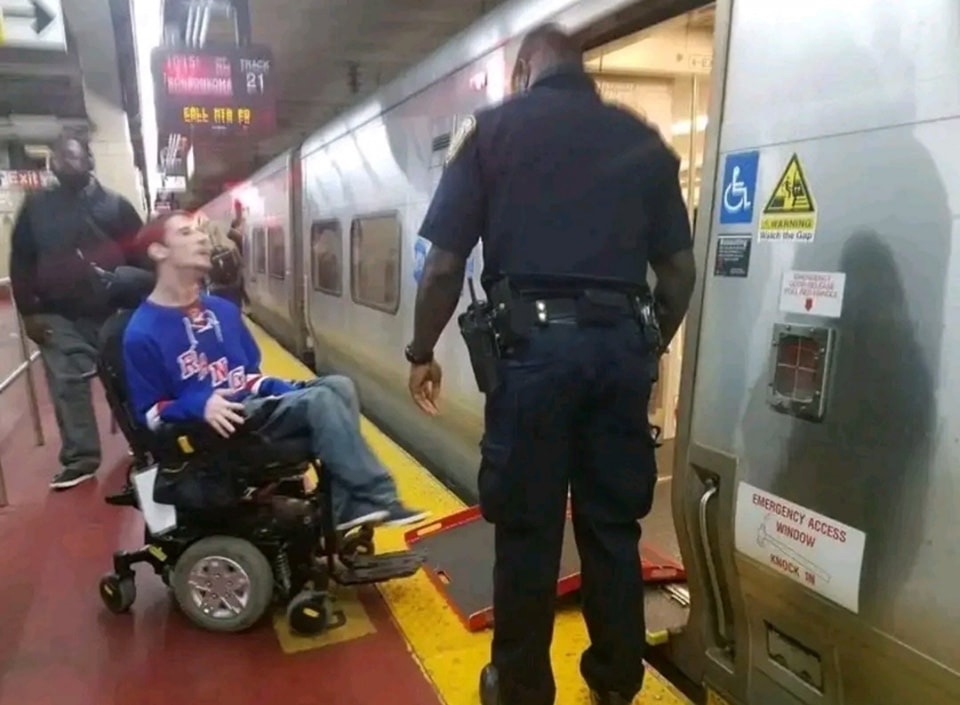
For Chris Scharrer, who depends on a 350-pound power wheelchair, Penn Station should have been accessible. But when they reached the elevator — the only way down — it was out of order. No warning. No backup. No options.
The realization hit hard: without that elevator, there was no way to get Chris down to the trains. It was either the elevator… or nothing.
And then, into that moment of fear, stepped a man in blue.
Officer Mears
His name was Officer Mears. Calm, steady, and kind, he immediately saw what was happening and quietly took charge. There was no hesitation, no frustration, only compassion.
He walked with them, block after block, until they found another working elevator tucked away in a KMart. He didn’t leave their side. He didn’t treat them as an inconvenience. He treated them as human beings who deserved dignity.
When they finally reached the LIRR, Officer Mears went further still. Before the rush of commuters arrived, he found out what track their train would be on and personally escorted them there. Then, with care and patience, he set up the ramp so Chris could board before the crowds.
He stayed until he was sure they were safe.
During the walk, Officer Mears shared something that explained the depth of his compassion. Before joining the police force, he had worked with the disabled for six years. “That’s where my heart is,” he said quietly.
And you could tell.
Every step he took, every small act of service, came from a place of genuine care. He wasn’t just doing his duty. He was living his calling.
A Night to Remember
What could have been the worst part of the night turned into something unforgettable. Not just because of the hockey win, but because of the reminder that humanity still shines in unexpected places.
Chris got on that train safely. His dignity intact. His heart lifted. And all because one officer chose to see him, not as a problem, but as a person.
The river glistened in the morning light, its current gentle but steady, when a small drama unfolded that would soon touch hearts across the world.
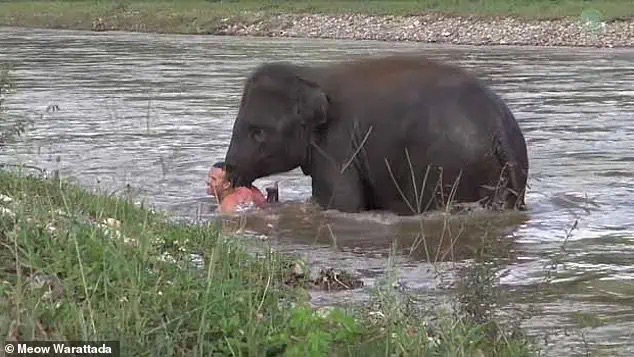
On one bank, a man splashed, calling out as if in distress. His voice carried across the water, urgent yet uncertain. And on the opposite side, a young elephant named Kham Lha froze, ears flapping, eyes fixed on him.
She didn’t hesitate.
With a burst of determination, the five-year-old elephant plunged into the river, pushing against the current with all her strength. Her little legs churned through the water, her trunk lifted high. To her, there was only one thought — he needs me.
This wasn’t just any man. It was Darrick Thomson, her trainer and closest companion.
A Bond Forged from Pain
When Kham Lha first arrived at Elephant Nature Park in Chiang Mai, she was broken in spirit. Like too many young elephants in Thailand, she had endured a brutal process known as “the crush” — a practice designed to strip away an elephant’s will, using ropes, chains, and pain to force submission for the tourism industry.
By the time she was rescued, Kham Lha was frail, frightened, and mistrustful. She had known humans only as a source of suffering.
But then came Darrick. Patient. Gentle. Unwavering. He didn’t demand obedience. He offered kindness. He gave her space, food, care — and, in time, his friendship. Slowly, Kham Lha learned that not all humans bring pain. Some bring love.
The Rescue That Wasn’t
And so on that day by the river, when Darrick pretended to struggle in the water, Kham Lha reacted not with fear, but with courage.
She pushed through the current, her trunk reaching for him, wrapping around his body. At one point, she even tried to lift him with her leg, determined to shield him from harm.
Darrick, smiling through the splashes, clung to her in return. The moment was not staged for amusement. It was a revelation — a young elephant, once broken by cruelty, had found such trust in a man that she believed his life was worth saving.
A Lesson for Us All
Darrick later reflected, “Kham Lha was in a terrible state when she arrived. But elephants are incredible. If you show them warmth and care, they respond in kind.”
At Elephant Nature Park, Kham Lha now roams freely with her herd, no longer chained, no longer afraid. Her story — and that short clip of her rushing to help — is more than just a viral video. It is a living reminder that compassion heals.
That even those who have suffered the deepest wounds can still choose love when shown kindness.
And perhaps, that humanity, too, can learn something from the sight of a little elephant running into a river — not for herself, but for a friend.
It was a bright, seemingly ordinary morning off the coast of South Africa. The sun glinted off the rolling waves, and a gentle breeze carried the salty tang of the ocean across the deck of a small fishing vessel. A group of friends, passionate about the sea, had set out for what they imagined would be a day of leisure and camaraderie. They were ready for a simple fishing expedition, anticipating nothing more than the thrill of the catch and laughter shared under the wide, open sky. Yet, in a matter of moments, their tranquil outing would descend into chaos, fear, and ultimately, an unforgettable story of courage and resilience.
The adventure began peacefully. Lines were cast into the deep blue, bobbing gently in the calm water. The rhythmic sway of the boat, the distant cry of seagulls, and the occasional splash of fish breaking the surface created a sense of serenity that only the ocean can provide. For the friends, this was a chance to bond, to escape the monotony of daily life, and to immerse themselves in the raw beauty of nature. But the ocean, in all its majesty, is as unpredictable as it is breathtaking.
Suddenly, a commotion erupted near the waterline. One of the friends, leaning over the side of the boat, was attacked by a shark. Panic surged through the group as they watched in horror. The shark, a powerful predator nearly four meters long, struck with alarming speed and precision. Blood tinged the otherwise pristine water, and the realization of imminent danger hit with a visceral force. Adrenaline flooded every vein, hearts raced, and instincts screamed to act.
The attack was brief, yet the consequences were severe. The friend narrowly escaped death, his survival owed partly to luck and partly to the quick reactions of those around him. Shouts echoed across the water as the group scrambled to fend off the shark, their fear mixing with a sense of helplessness. It was a moment that underscored the raw, primal power of nature—a reminder that the ocean, for all its beauty, is also home to forces far beyond human control.
Yet, amid the terror, something remarkable began to unfold. The shark, seemingly as wary of the humans as they were of it, eventually retreated into the depths. The immediate danger had passed, leaving the group shaken but profoundly aware of the fragile line between life and death. It was a harrowing introduction to the unpredictable dynamics of marine life, and it planted a seed of respect and awe for one of nature’s most iconic creatures.
The Call to Rescue: A Daring Mission to Save a Shark
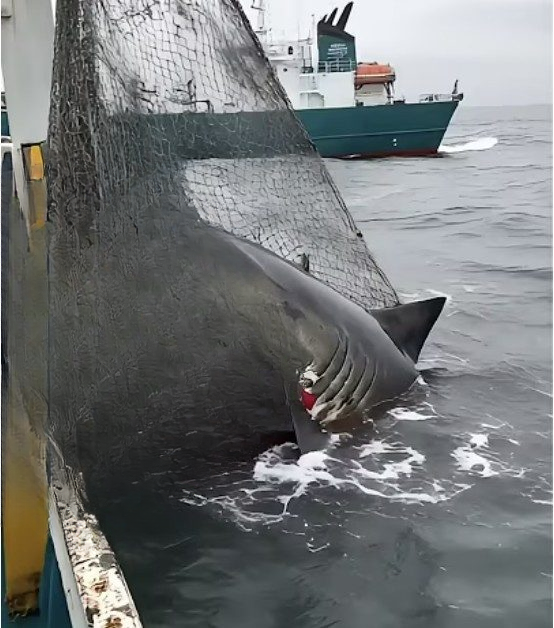
As the friends recovered from the shock, another story was unfolding nearby, one that would intertwine with their experience in an extraordinary way. A local fisherman had reported seeing a great white shark ensnared in a labyrinth of discarded fishing nets. The massive predator, a symbol of strength and dominance in the ocean, was struggling desperately. The nets had cut into its flesh, leaving it weakened and in grave danger.
Dr. Emily Carter, a renowned marine biologist with decades of experience studying shark behavior, received the distress call and mobilized her team immediately. Every minute counted. The longer the shark remained trapped, the greater the risk of infection, exhaustion, or death. Dr. Carter, known for her calm demeanor even in high-pressure situations, briefed her team meticulously. Safety was paramount, but so was urgency. They were not only facing a formidable predator but also the unpredictable temperament of a creature fighting for survival.
The team’s research vessel cut smoothly through the calm sea, the sunlight reflecting off the water in sparkling patterns. Each member of the crew carried a sense of purpose. They were here to save life, to intervene in a scenario where human negligence—abandoned fishing gear—had imperiled one of the ocean’s most magnificent inhabitants. The mission required precision, courage, and a deep understanding of shark behavior.
When the shark’s dorsal fin appeared on the horizon, the team could see the severity of the situation. It was enormous, a magnificent specimen nearly four meters long, yet weakened by entanglement. Its powerful body was constrained by the unforgiving mesh of synthetic nets, which dug painfully into its flesh with every movement. The scene was both terrifying and heartbreaking. The shark was alive, yes, but barely. Each struggle to free itself tightened the bonds, a cruel paradox of survival.
The Rescue Operation: Balancing Risk and Compassion
Dr. Carter’s team deployed a small, agile dinghy, outfitted with specialized cutting tools and poles. Every maneuver was deliberate; any misstep could provoke the shark or worsen its injuries. The ocean’s surface, so calm moments before, now felt charged with tension. Each wave seemed amplified, each shadow beneath the water a potential hazard.
As they approached the entangled shark, its eyes met theirs—sharp, intelligent, and wary. The creature was alive not just in body but in mind, aware of the humans encroaching upon its confined space. Dr. Carter directed the dinghy with precise control, positioning her team for the most effective and safest angles to cut the nets. Every action had to be calculated. Even the smallest slip could trigger a defensive lunge.
Minutes stretched into an eternity as cutters bit through the synthetic strands. The team synchronized their movements, communicating through gestures and hushed words to avoid startling the already stressed predator. The shark, recognizing that the humans posed no threat beyond the tools they wielded, remained surprisingly still. It was an unspoken collaboration, a delicate dance between human skill and animal instinct.
Just as hope seemed within reach, the unexpected happened. The shark, sensing its freedom, erupted with raw, primal energy. The dinghy rocked violently, sending waves crashing over the sides. Adrenaline surged, fear and awe colliding in equal measure. For a few heart-stopping moments, control was tenuous, the line between rescue and disaster razor-thin.
Then, as abruptly as the chaos began, the shark calmed. No longer ensnared, it circled the dinghy with a graceful, almost majestic awareness. Its movements were deliberate, as though acknowledging the team’s efforts. This silent moment of connection transcended language or species; it was pure, mutual respect forged under extreme circumstances. Eventually, the shark turned and swam back into the depths, a dark silhouette fading into the vast ocean.
Back on the research vessel, relief and exhilaration replaced tension. The team’s hearts swelled with a mixture of pride and gratitude. They had saved a life, confronted danger, and witnessed the profound intelligence and resilience of one of the ocean’s apex predators. The experience left an indelible mark, not just as a professional triumph but as a deeply human moment of empathy and courage.
Reflections on Human Responsibility and Marine Conservation
The incident had a ripple effect beyond the immediate circle of those present. News of the rescue traveled quickly, capturing the imagination of the public and raising awareness about the dangers marine life faces from human activity. Discarded fishing gear, plastic pollution, and careless interactions with wildlife contribute to countless injuries and deaths among oceanic species.
Experts like Dr. Carter emphasize that such encounters, while dramatic, highlight the urgent need for conservation efforts. “Every shark saved is a small victory for the ocean,” she noted. “It reminds us that human intervention can be a force for good, but only when guided by knowledge, caution, and respect for the natural world.”
Sharks, despite their fearsome reputation, play a critical role in maintaining the health of marine ecosystems. They regulate species populations, contribute to the balance of the food chain, and serve as indicators of ocean health. Protecting them is not just an act of compassion—it is essential for sustaining life beneath the waves.
Lessons Learned from the Ocean’s Edge
The near-fatal attack and subsequent rescue offered lessons that extend far beyond the immediate drama. For the friends who experienced the shark attack firsthand, it was a stark reminder of the ocean’s power and unpredictability. Fear, they realized, is a natural response, but so too is resilience, quick thinking, and the capacity to act in defense of life—whether human or animal.
For the rescue team, it reaffirmed their commitment to conservation and education. Their work is not only about saving individual animals but about fostering awareness, inspiring others, and demonstrating that humans can coexist responsibly with the natural world. The silent acknowledgment of the freed shark became a symbol of what can be achieved when empathy guides action, when courage is tempered with care, and when knowledge meets compassion.
The Broader Impact: Inspiring Change and Respect
Stories like these resonate deeply because they touch on universal themes: fear, survival, compassion, and respect for life. They remind us that the natural world is not a backdrop for human adventure but a living, breathing system with its own rhythms, intelligence, and vulnerabilities. The incident off the coast of South Africa serves as both a thrilling narrative and a call to action—a reminder that the choices humans make have far-reaching consequences for the planet’s most magnificent creatures.
The shark’s survival, thanks to human intervention, sparked conversations, inspired campaigns, and even influenced local policies on marine debris and sustainable fishing practices. Communities, students, and environmental groups shared the story widely, drawing attention to the fact that each of us can play a role in protecting the ocean’s inhabitants.
Conclusion: A Day That Changed Perspectives Forever
In the end, the fishing trip that began with excitement and leisure became a profound encounter with life’s fragility and resilience. A friend narrowly escaping a shark attack, coupled with the extraordinary rescue of another, highlighted the dual nature of the ocean: beautiful yet dangerous, vulnerable yet powerful.
Dr. Carter and her team’s efforts underscore a vital lesson: humans have the ability to effect real change when knowledge, courage, and empathy converge. The shark’s silent acknowledgment of its rescuers, as it disappeared into the deep, was more than a moment of grace—it was a testament to the interwoven fates of humans and the creatures with whom we share this planet.
As the sun set over the South African coastline, painting the sky in hues of orange and pink, the team and the friends reflected on the extraordinary day. It was a story they would tell countless times, a memory etched not only in their minds but in the hearts of everyone who would hear it—a reminder of the fragile yet awe-inspiring bond between humanity and the wild world that surrounds us.
What started out as an ordinary traffic stop on a Friday morning in Nashville soon unraveled into a dramatic and deadly confrontation that seemed more fitting for a crime drama than everyday reality.
Behind the wheel of a car linked to a wanted felon sat a woman who, at first glance, appeared cooperative—calm enough to lull suspicion. Yet within minutes, the interaction turned violent.
Body-worn and dashboard camera footage later released to the public captured a harrowing sequence of events, leaving observers to question whether this was a reckless act of desperation, an attempt to shield a criminal, or something even more complicated.
In mere seconds, a routine stop descended into chaos, leaving one officer severely wounded and a woman fatally shot, as the city grappled with the shocking outcome.
Authorities confirmed that the confrontation ended with the death of 31-year-old Nika Holbert, who opened fire on a police officer during the stop. The officer, though gravely injured, managed to return fire. The released footage has since shed light on exactly how the encounter spiraled out of control, but it has also raised difficult questions about how such tragedies escalate so quickly.
According to Metro Nashville Police, Officer Josh Baker pulled over a black Chevrolet Camaro around 9:30 a.m. on Friday. The car was registered to 42-year-old Demond Buchanan, a convicted felon wanted on six outstanding drug-related warrants. However, the man himself was not behind the wheel. Instead, it was Holbert—whose relationship to Buchanan remains unclear.
Video recordings from the officer’s body camera and patrol car show Baker speaking with Holbert before discovering a small bag containing a suspicious powder inside her purse. When Baker attempted to arrest her, she refused, repeatedly shouting that she had “done nothing wrong.”
The department’s chief, John Drake, later explained that the immediate release of the footage was intended to ensure public transparency in such a sensitive case.
As Holbert resisted, the tension escalated. She slipped back into the driver’s seat while Baker, in an attempt to stop her from fleeing, used his Taser. The device, however, did not subdue her. In the midst of the struggle, Holbert pulled a handgun. The footage captures Baker urgently yelling, “Ma’am, put the gun down!”—but the warning came too late. She fired directly at him.
The bullet struck Baker below his protective vest, causing a serious injury. Despite being hit, the 14-year veteran officer returned fire while Holbert sped away in the Camaro. She managed to discard her weapon but crashed just a block away. She was rushed to Skyline Medical Center, where she was later pronounced dead from a gunshot wound.
Though gravely hurt, Baker was able to radio for help, reporting “shots fired” and alerting dispatchers that he had been struck. He was transported to Vanderbilt University Medical Center, where surgeons operated on him. Officials later confirmed that he was in stable condition and expected to recover.
The Tennessee Bureau of Investigation has taken charge of the case, with plans to present its findings to the District Attorney once the review is complete.
Metro Police Chief John Drake defended Officer Baker’s response, pointing out that the officer tried multiple non-lethal measures, including verbal commands and a Taser, before firing his weapon in self-defense.
Meanwhile, Holbert’s adoptive mother, Lisa Holbert-Gooch, spoke publicly about the loss. She acknowledged that her daughter’s decision to draw a firearm against a police officer was wrong but expressed deep sorrow and unease about the way the incident unfolded. Her words reflected the complex grief of a family torn between acknowledging fault and questioning the fatal outcome.
This tragic confrontation highlights the razor-thin line between order and chaos during even the most routine encounters with law enforcement. The release of the footage provides much-needed clarity but cannot erase the haunting questions surrounding split-second choices made in moments of fear and panic.
For the police department, the case reinforces the daily risks officers face and their commitment to openness with the community. For Holbert’s family, it is a devastating reminder of how quickly resistance, mistrust, and fear can escalate into irreversible consequences. As the investigation continues, Nashville is left to reflect on the fragile balance between enforcement and escalation—where one decision can change lives forever.
When Marine veteran John Harkness and his wife Lynn are asked to leave Walmart while collecting for Toys for Tots, they never expected the incident to go viral.
What begins as a misunderstanding quickly spirals into a national debate about respect for veterans and corporate policies. As the story unfolds, the couple faces unexpected challenges and opportunities.
Will they be able to continue their mission of bringing joy to underprivileged children? And how will the community respond to this controversy?
It began as an ordinary dive. Off the coast of Portugal, a professional diver descended into the blue to perform routine underwater repairs. His focus was on his work — checking bolts, adjusting fittings, ensuring the equipment held steady against the currents. At first, he barely noticed the shadow moving nearby.
An octopus hovered close, its eight arms curling and unfurling with quiet precision. Encounters like this weren’t unusual. Curious octopuses often observed divers, drifting just close enough to watch before vanishing into the rocks. The diver gave it little thought — until something unexpected happened.
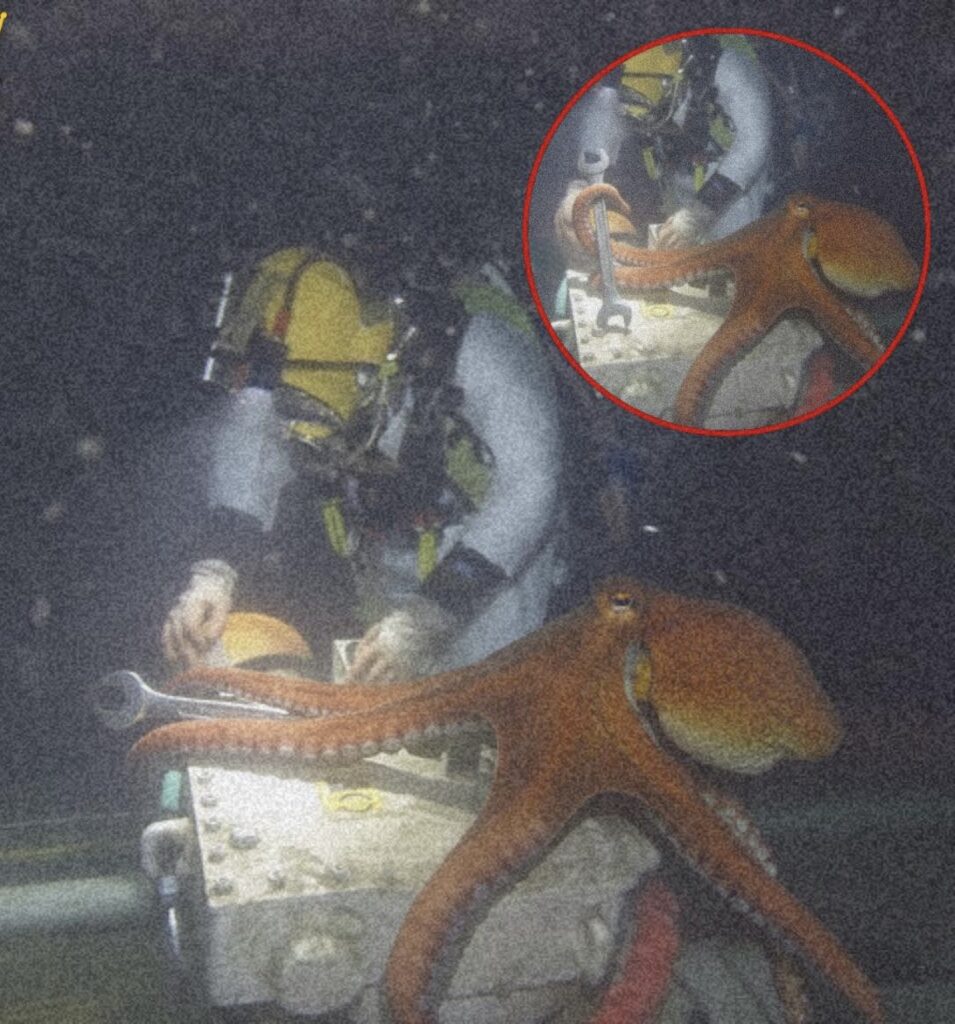
When he reached for a wrench, a tentacle slipped into view, nudging it toward him. Later, when a bolt drifted out of reach, the octopus plucked it from the sand and handed it back. Each time he dropped a tool, the same thing happened: the octopus retrieved it calmly, passing it back with uncanny timing, like a silent assistant from the deep.
At first, the diver laughed it off, unsure if it was coincidence. But the behavior continued dive after dive. The octopus seemed to understand, watching his movements, anticipating what he needed, and responding with surprising accuracy.
When he surfaced and shared the story, no one believed him. Colleagues teased him, saying he had spent too much time underwater. Friends chuckled, insisting octopuses didn’t “help,” they scavenged. The diver, however, knew what he had experienced.
Determined to prove it, he set up cameras on his next dive. The footage captured what words could not. Frame by frame, it showed an octopus moving with purpose, collecting tools, and gently passing them into the diver’s gloved hands. Not snatching, not fleeing — helping.
The video spread quickly online, mesmerizing viewers across the globe. Millions watched as the octopus assisted with quiet diligence, each gesture challenging the way humans view marine life. Was it curiosity? Intelligence? Empathy? Whatever the reason, the result was the same: a diver and an octopus working side by side.
Marine biologists who reviewed the footage were fascinated. Octopuses are known for their intelligence, problem-solving skills, and playful curiosity. Some even use tools in the wild. But to see one engage in what looked like cooperative behavior with a human was something rare. “It’s extraordinary,” one researcher noted. “This suggests a level of observation and adaptability we’re only beginning to understand.”
For the diver, however, the science mattered less than the experience itself. Asked about the encounter, he only smiled. “I’m just happy I had help down there,” he said.
To him, it wasn’t about proving anything. It was about connection — the strange, beautiful moment when two species met not as predator and prey, not as intruder and resident, but as partners in a shared task. In the quiet blue of the ocean, where words could not be spoken, the octopus had chosen action instead.
The story resonated deeply with people around the world. In an era often defined by division, here was a reminder that cooperation transcends boundaries — even species. That kindness can be expressed not only through words, but through gestures. That sometimes, help comes from the most unexpected places.
The octopus has not been seen since, drifting back into the anonymity of the deep. But the footage remains, a testament to one extraordinary encounter between man and sea.
And for the diver, each time he returns to those waters, he can’t help but glance into the shadows, half-hoping to see a familiar shape, eight arms ready to lend a hand once more.
It began as just another call in Jacksonville. A homeless man, stranded in his electric wheelchair, sat helplessly on the sidewalk. The chair had lost power. With no way to move forward and no way to transport the heavy device in a police cruiser, he was stuck.
That’s when Officer Matt Krueger arrived.
The man couldn’t take a step. The fire department said they couldn’t transport him either. Most people would have seen an impossible situation. But Officer Krueger saw only a human being in need.
So he did what many might not even consider. He leaned into the back of the powerless chair, gripped the handles, and began to push.
Seven Blocks of Compassion
Block after block, the officer pushed the man through busy intersections, down long stretches of sidewalk, under the Florida sun. The chair wasn’t light — once the motor lost power, maneuvering it was like pushing a small car. But step by step, he moved them forward together.
Seven blocks later, they arrived at the Sulzbacher Center — a place where the man could get a hot meal, a safe bed, and help with placement services. What had started as a desperate, immovable moment had ended in dignity and care.
Along the way, something else happened. A friendship began.
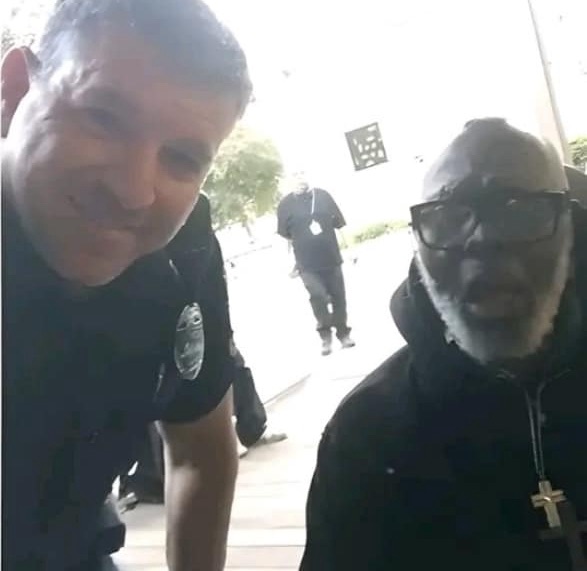
The man, once frustrated and stranded, now smiled beside the officer. And before leaving, Officer Krueger pulled out his phone, snapped a selfie, and captured the moment. Not for glory. Not for praise. Just as a reminder of what one simple act of service can mean.
Witnessed and Remembered
Ms. Jean Lloyd, who happened to see the first part of the scene, shared photos of Officer Krueger’s actions. “Thank you to JSO Officer Matt Krueger for your good Samaritan work yesterday,” she wrote. “A homeless man was stranded in his electric wheelchair because it lost power. Officer Krueger pushed this man seven blocks to the Sulzbacher Center for a meal and adult placement.”
Soon after, Officer Krueger himself reflected on the moment: “Pushed this man who was broken down in a motorized wheelchair seven blocks to a shelter. It would not fit in my police car, JFRD said they could not transport, and he couldn’t walk one step. Those things aren’t easy to push when they are out of juice — but we became friends, and we took a selfie.”
What might have looked like an inconvenience became a powerful reminder of what true service is all about. A uniform, a badge, a gunbelt — they symbolize authority. But on that day, they also symbolized compassion, humility, and a willingness to do the hard thing simply because it was the right thing.
Seven blocks. A heavy wheelchair. And a lesson: sometimes serving your community isn’t about the calls you answer, but about the moments where you stop, push forward, and walk beside someone until they’re safe.
Great work, Officer Krueger. You didn’t just push a wheelchair. You carried hope, dignity, and kindness with every step.
The boy was tiny. His arms barely wrapped around the blanket, his voice high and breaking as sobs filled the hospital room. He was scared — scared of the bright lights, the strangers in scrubs, the unfamiliar beeping of machines that seemed to surround him on every side. At that age, everything feels larger than life, and in that moment, the world must have felt impossibly big and terribly cold.
“The boy, obviously, being so small, became very upset,” the officer later explained. “He was crying. He was sobbing.”
Doctors and nurses worked steadily, doing what they could to ensure the child received the medical care he needed. They were attentive, professional, compassionate. But still — the boy could not stop crying. His little chest heaved with each sob, and his tears came faster than anyone could wipe away.
Watching from the side, the officer felt something stir inside him. His training had prepared him for danger, for emergencies, for protecting the public from threats. But nothing in a manual tells you what to do when a child’s cries pierce through all the noise and land straight in your heart.
He stepped forward and asked the simplest of questions: “Can I hold him?”
The hospital staff, recognizing both the child’s distress and the officer’s sincerity, agreed. And with that, the uniform — the badge, the belt, the layers of gear — faded into the background. He was no longer an officer enforcing order. He was just a human being responding to another human being’s need.
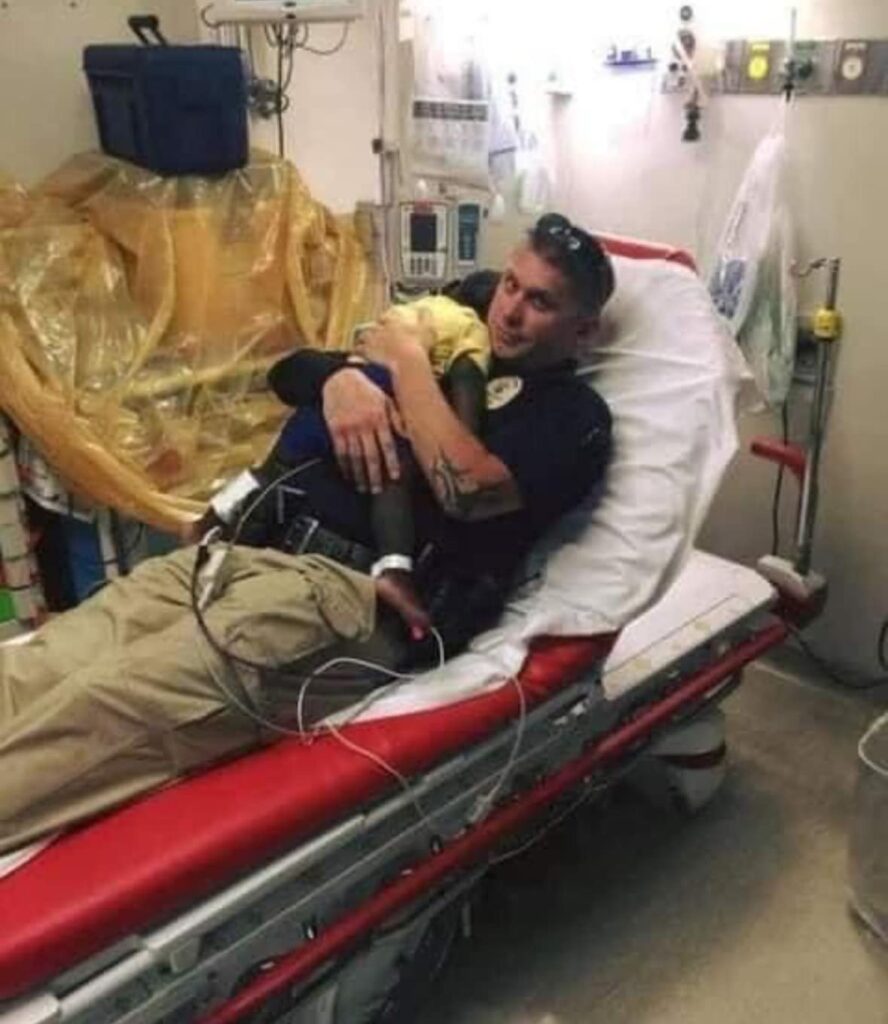
“I picked him up,” he said. “Minutes later, I was standing and he was asleep on my chest.”
It was almost immediate. The boy, who moments before had been inconsolable, began to calm in the safety of someone’s arms. His sobs slowed. His breathing softened. His head tucked against the officer’s chest, and within minutes, he drifted into sleep.
But as the child relaxed, the officer realized something practical: his own body armor and gun belt made it difficult to hold the boy for long. “With all my body armor and my gun belt, it became very heavy holding this small child,” he admitted. “So that’s when I decided to sit down on the bed and make it easier for him and me.”
So there he sat, on the edge of a hospital bed, a grown man in uniform cradling a child small enough to disappear against him. He stayed there quietly, careful not to wake him, letting the boy’s exhaustion finally give way to rest.
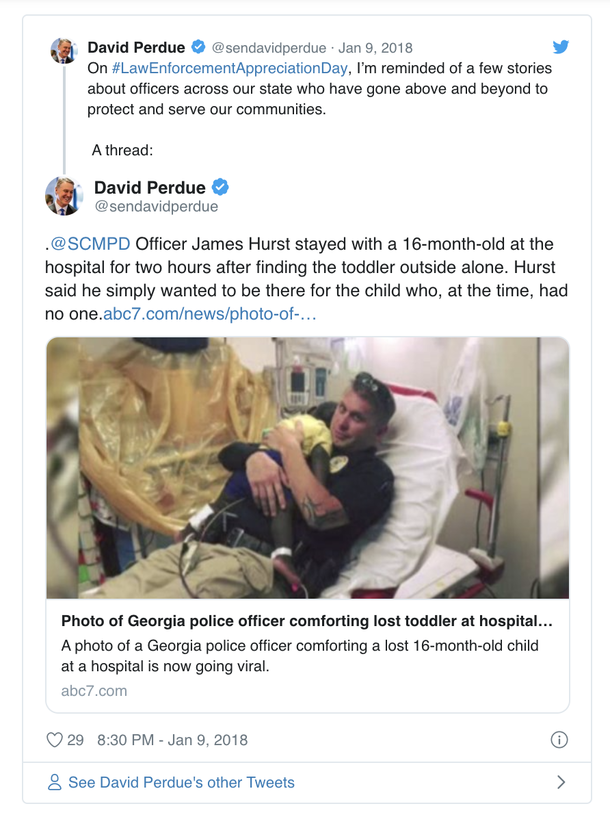
“I just knew this child needed somebody to be there for him,” the officer said later. “It was just human instinct; humanity. The hospital staff was taking great care of him, but he was sobbing and crying. I picked him up and within minutes, he was asleep on my chest.”
Those who witnessed it would not forget the image. The badge and the gun were still there, but so was something deeper — compassion, tenderness, humanity. In a world where headlines often highlight conflict, this was a reminder that at the heart of service is the willingness to care.
In that hospital room, the boy’s fear dissolved, replaced by the steady rhythm of a heartbeat he could trust. And in that same room, an officer showed that sometimes the greatest act of protection is not stopping danger, but simply being a safe place for someone too small to carry their own fear.
It was not dramatic. It was not loud. It was quiet, ordinary even — a man holding a child until the child felt safe enough to sleep. But sometimes, those are the moments that matter most.
And in this case, those were the moments that reminded everyone watching that kindness can be the strongest part of the uniform.
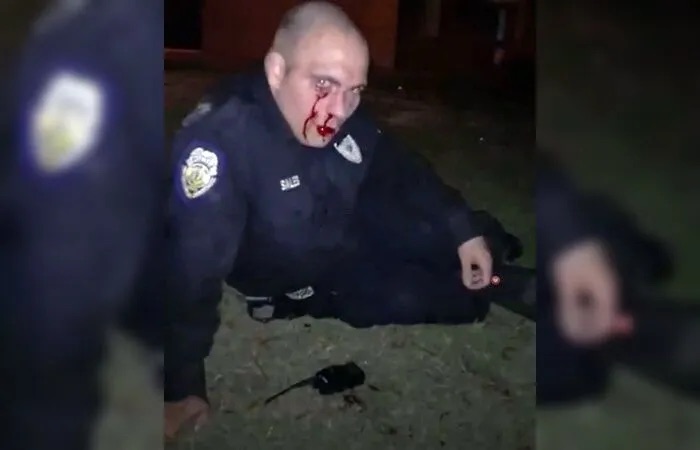
As a police officer tried to arrest an assault suspect, he found himself on the ground being brutally beaten. However, when the seriously injured officer pleaded with bystanders for help, all he received was ridicule.
Things took a violent turn when Officer Michael Sales attempted to arrest Jamel Alphonso Rogers. (Photo Credit: Screenshot)
Video footage circulated on social media, stirring outrage after Officer Michael Sales, 27, was overpowered and savagely beaten while trying to make an arrest in Rowland, North Carolina. The vicious attack was initially livestreamed on Facebook, but the fistfight isn’t even the most disturbing aspect of the footage.
The incident unfolded at approximately 1 a.m. when Officer Sales responded to a call about a domestic disturbance, as he was the only officer in the area, The Police Tribune reports. It was then that he encountered suspect Jamel Alphonso Rogers before things took a violent turn.
Officer Michael Sales suffered serious injuries as a result of the scuffle. (Photo Credit: Screenshot)
The video captures Officer Sales engaging in a physical confrontation with Rogers, who was allegedly resisting arrest. The suspect then prevents Sales from handcuffing him by repeatedly rushing him and taking out his legs. Once on the ground, Sales is brutally beaten several times, leaving him bloodied and dazed.
Perhaps the most disturbing element of the incident is the crowd’s reaction to the officer’s struggle and subsequent injuries. The individual who livestreamed the scuffle to Facebook can be heard relentlessly mocking Officer Sales and inciting Rogers to continue the assault as other witnesses stand idly by.
“Let him whoop his a—! Let him whoop his a—!” an unidentified man can be heard telling Rogers.
“Don’t you let that man take you to f— jail!” the same man says.
Finding himself unable to defend himself, much less restrain Rogers, Officer Sales calls out for help. However, he quickly realizes that he is on his own as his cries are met with mockery.
“Well, you’re the police. Why Imma help you folk?” the onlooker responded, breaking into laughter.
“He f—kin’ that police up!” the onlooker yelled triumphantly, breaking into laughter yet again.
After the suspect once again overpowers Sales, sitting on top of him and punching him in the face, another man steps in and drags him off the officer. Of course, it isn’t long before the assault resumes and Officer Sales is beaten. Moments later, the suspect slams Sales into the side of the patrol car and punches him in the face. By this point, bystandersrealize that Officer Sales has lost possession of his service pistol in the midst of the brawl.
“Don’t let that man take you to damn jail,” he repeatedly yelled. “F—k that s—t…f—k the police!”
“Police scared as hell,” he laughed a moment later. “He said, ‘help me, y’all!’ That man asked me to help him, and he’s the goddamned police.”
“That man looking for his goddam gun,” he said. “Where your gun at? You ain’t got your gun! I’m gonna find that mother—ker…you can’t do nothin’ without your gun!”
The camera focuses on Officer Sales’ bloodied face as the person recording exclaims, “Damn, boy, you f—ked him up!” Dillon County deputies and Robeson County officers arrived on the scene soon after and arrested Rogers. He was then charged with assault with a deadly weapon, intent to kill while inflicting serious injuries, kidnapping, and two counts of resisting a public officer.
Officer Sales had to be airlifted to a local hospital and treated for multiple injuries, including a possible orbital fracture. His firearm and other gear were recovered at the scene.
The sheriff called the incident “the harsh reality” of what police officers are facing on a daily basis. (Photo Credit: Facebook)
Robeson County Sheriff Burnis Wilkins lamented the incident, calling it “the harsh reality that law enforcement in America is facing right now.” He warned that the incident is part and parcel of the “disregard for authority” as well as the demonizing and dehumanizing of police officers.
Many have pointed out that there was no good outcome for the situation. If the officer had responded successfully with force, the anti-police movement could have smeared him as a racist. Fortunately, the officer survived what so many others who refused to use lethal force to defend themselves haven’t.
LAS VEGAS (KLAS) – Two Las Vegas teens facing murder charges in connection with the death of a bicyclist appeared in court this week as a judge set their trial date.
A grand jury indicted Jesus Ayala, 18, and Jzamir Keys, 16, on Tuesday morning. The two are accused of stealing at least three cars, burglarizing a home, hitting another car on the road, and striking two bicyclists in separate incidents during an hours-long crime spree in August.
A 72-year-old man survived the first hit-and-run. The other man — retired California police chief Andreas Probst, 64 — did not survive.
In court on Tuesday, Ayala and Keys appeared to smile at the widow and daughter of Probst.
“They started trying to intimidate us, mad-dog us,” Taylor Probst, the victim’s daughter, said. “These guys, they did not respect the court whatsoever.”
The teens also appeared to communicate with each other and, at times, cover their faces. Video from inside the courtroom appears to show them laughing at one point.
On Monday, Nexstar’s KLAS obtained additional evidence at the center of the case that included body-camera video in the moments after Ayala was taken into custody.
“It’s just a [expletive] hit and run, slap on the wrist,” Ayala is heard telling a Las Vegas Metro police officer.
Taylor Probst said she believed the evidence would help in the prosecution of the teens.
“It shows that they really have no remorse, that this is just a game to them. Like they don’t, they really don’t care if anyone else lives or dies,” she said. “They don’t care about themselves if they live or die.”
She also said she believed that the teens’ parents were to blame.
“A multitude of different people failed, but I think ultimately the parents, they’re the ones who failed,” she said.
Andreas Probst’s widow, Crystal Probst, plans to continue to attend the teens’ court appearances with Taylor Probst to seek justice and to also put a face on a victim of the teens’ alleged crimes. Crystal Probst is also wearing her late husband’s Apple watch to court — the same watch he was wearing when he was struck in August.
“Keeping him close reminds me he’s here with me in the courthouse, you know, to fight for him,” Crystal Probst said.
Both of the accused teens, who were minors at the time of the crash, are being tried in the adult court system. A district judge has set their trial date for Sept. 16, 2024.
Taylor Probst told reporters she wants the teens to receive the death penalty. However, that is not possible as they were juveniles at the time of the alleged crime spree.
Sometimes Angels Wear Blue.
The Elephant Who Tried to Save Her Friend.
A Near-Fatal Shark Encounter: When a Fishing Trip Turns into a Life-or-Death Rescue
Nashville Chaos: Shootout at Traffic Stop Leaves One Dead, Officer Wounded
Marine Kicked Out Of Walmart Store Because Of Uniform – What Happens Next Went Completely Viral!
The Helping Octopus: An Unlikely Partner Beneath the Waves
A Long Push, A Quiet Kindness.
A Child’s Cry, An Officer’s Instinct.
Bystanders Ridicule Cop As He’s Beaten By Man He Tries To Arrest
Las Vegas teens accused in deadly crime spree appear to laugh in courtroom, smile at victim’s family